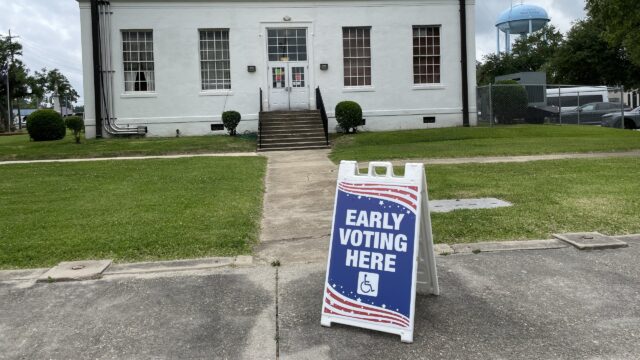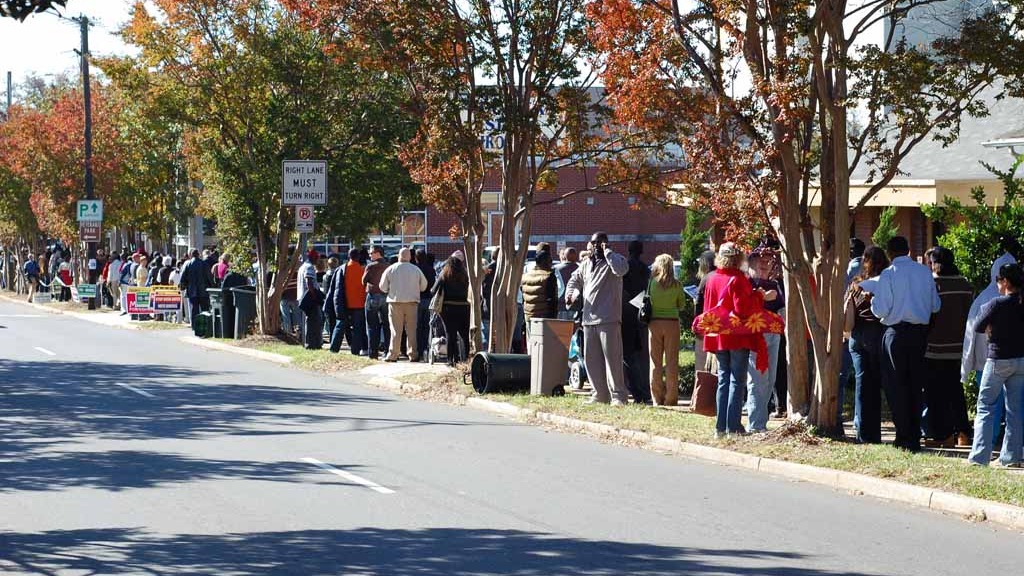
Photo: File photo, Oct. 31, 2008. James Willamor, CC BY-SA 2.0, cropped, via Wikimedia Commons.
More than 1.77 million ballots have been accepted in North Carolina, 36.6% above the 2022 midterm pace, with one-stop early voting ending at 3 p.m. Saturday.
Numbers as of 5:21 a.m. ET Tuesday, Oct. 27, 2026, covering ballots accepted through Monday, Oct. 26.
North Carolina early voting 2026 totals reached 1,773,890 accepted ballots through Monday, Oct. 26, according to the State Board of Elections absentee data. That is 36.6% more than the 1,298,679 ballots accepted at the same point before the 2022 midterm, measured the same number of days before Election Day. Election Day is Tuesday, Nov. 3, seven days away.
The 2026 total already equals about 81% of the 2,198,550 early in-person and mail ballots North Carolina accepted in all of 2022. Nearly all of the growth is in person: 1,708,049 ballots came through one-stop early voting, up 42.6% from 1,197,975 in 2022. Mail ballots totaled 65,841, down 34.6% from 100,704.
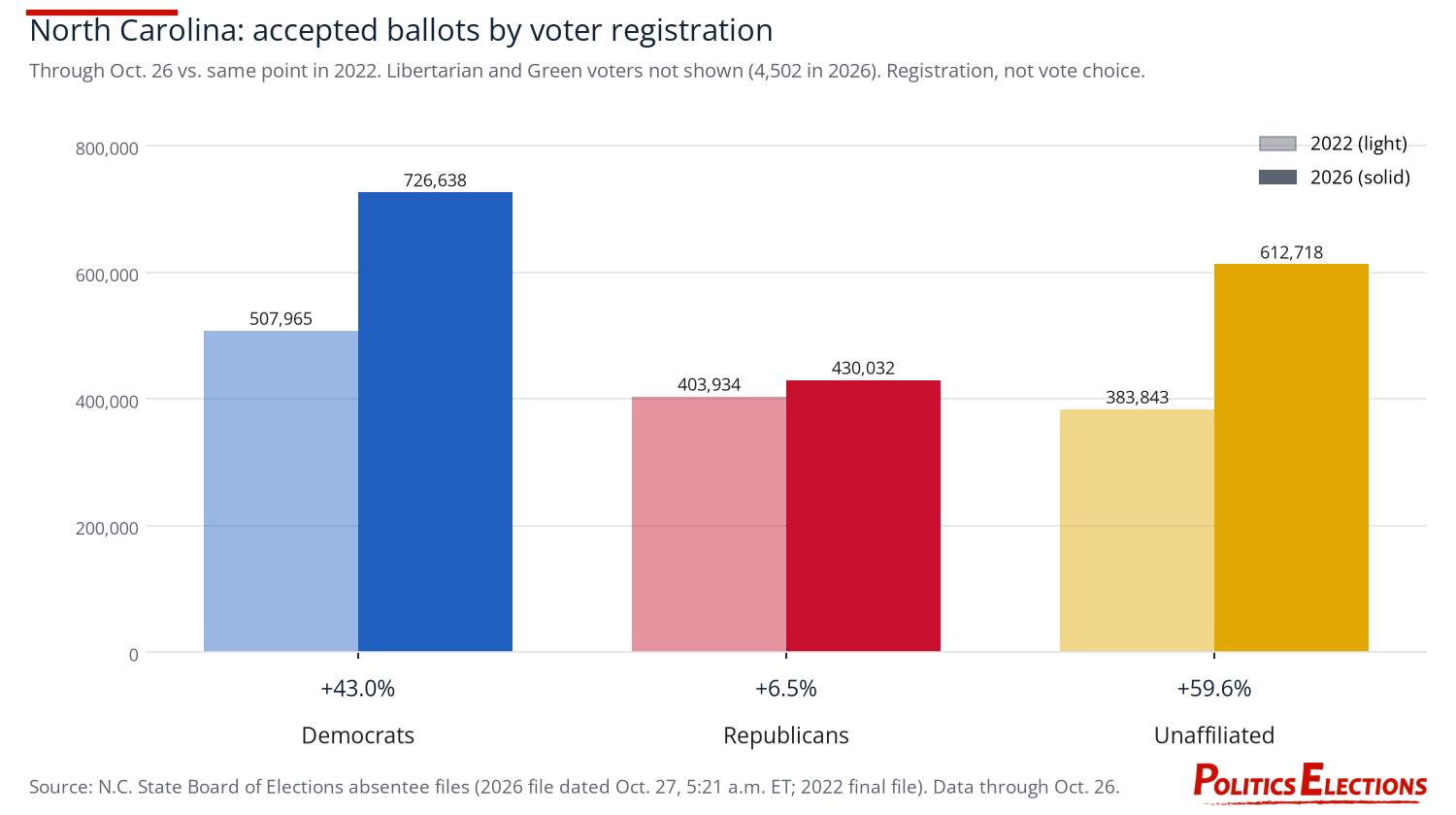
North Carolina early voting 2026: ballots by party registration
Registered Democrats account for the most accepted ballots, 726,638, followed by unaffiliated voters at 612,718 and registered Republicans at 430,032. Unaffiliated voters show the fastest growth, up 59.6% from the same point in 2022. Democratic ballots are up 43.0%, and Republican ballots are up 6.5%.
| Registration | 2026 | 2022 | Change |
|---|---|---|---|
| Democratic | 726,638 | 507,965 | +43.0% |
| Unaffiliated | 612,718 | 383,843 | +59.6% |
| Republican | 430,032 | 403,934 | +6.5% |
| Libertarian and Green | 4,502 | 2,937 | +53.3% |
| All accepted ballots | 1,773,890 | 1,298,679 | +36.6% |
Party registration is not vote choice. It shows how a voter is registered, not how that voter cast a ballot, and unaffiliated voters can back candidates of any party. Democrats’ share of accepted ballots is 41.0%, up from 39.1% in 2022. The Republican share is 24.2%, down from 31.1%, while the unaffiliated share is 34.5%, up from 29.6%.
Daily pace, counties and same-day registration
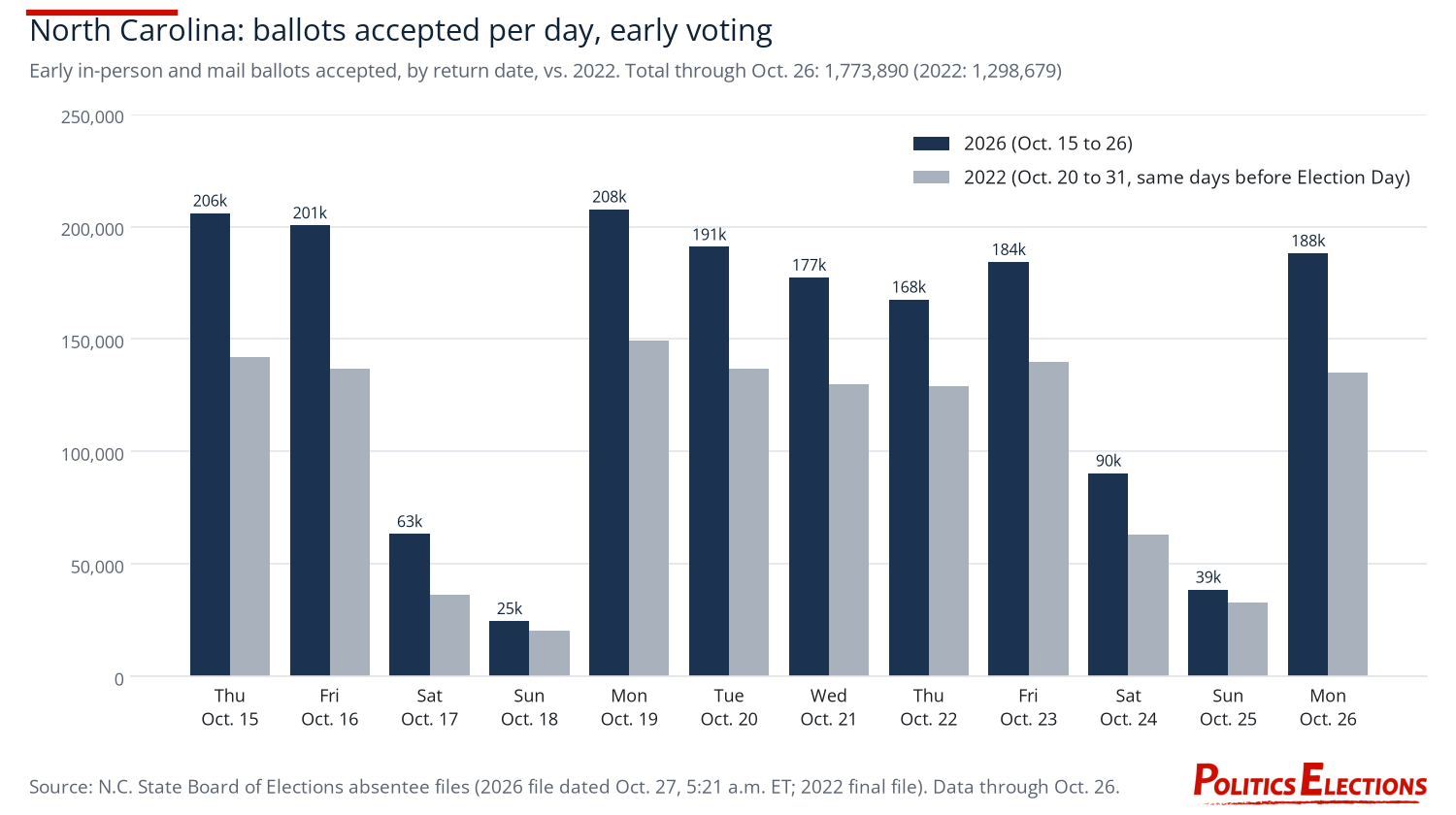
North Carolina has accepted at least 167,000 ballots on every weekday since in-person early voting opened Thursday, Oct. 15. Monday’s count was 188,217. Every one of the 12 days so far is above the comparable day in 2022, including weekends: 63,420 on Saturday, Oct. 17, and 90,419 on Saturday, Oct. 24.
Wake County leads with 222,894 accepted ballots, up 52.6% from 146,078 at the same point in 2022. Mecklenburg County has 185,830, up 55.2% from 119,707. Guilford (93,331), Durham (77,203) and Forsyth (69,097) follow.
Same-day registrants have cast 17,110 of the accepted ballots, up 34.3% from 12,738 in 2022. State election officials say same-day registration is available at any early voting site in a voter’s county during the early voting period. For how North Carolina’s rules compare with other states, see the Politics Elections guide to same-day voter registration.
In-person early voting period: Starts: Thursday, Oct. 15. Ends: 3 p.m. Saturday, Oct. 31.
N.C. State Board of Elections, Vote Early in Person
Rules for the final days of early voting
- Hours vary by county. The State Board of Elections says county boards set site schedules within state minimums, so voters should check their county’s early voting sites and hours on the Board’s early voting page.
- Photo ID is required when checking in to vote in person, according to the State Board of Elections. A voter without ID can complete an ID Exception Form, or vote a provisional ballot and bring an acceptable ID to the county elections office by noon on the fifth business day after Election Day.
- Mail ballots must be returned by 7:30 p.m. on Election Day, Nov. 3 (military and overseas voters have different deadlines), per the Board’s election calendar. The deadline to request one passed Oct. 20. Voters can also hand a mail ballot to their county board office or an election official at an early voting site while it is open.
- The registration deadline for most voters was Oct. 9, apart from same-day registration during early voting. Same-day registrants must have lived in their county for at least 30 days before Election Day and provide proof of residence.
What is on the North Carolina ballot
North Carolina voters will decide one U.S. Senate seat and 14 U.S. House seats, along with state court, legislative and local offices, according to the State Board of Elections. The Senate ballot lists Roy Cooper (Democratic), Michael Whatley (Republican), Shannon W. Bray (Libertarian) and Michael Dublin (Green), according to the Board’s general election candidate list.
Two recent polls of likely voters put Cooper ahead. The Elon University Poll, fielded Sept. 29 to Oct. 8, found Cooper at 52% and Whatley at 39%, with 6% undecided. The Carolina Journal poll, released Oct. 22, found Cooper at 49.4% and Whatley at 39.1%, a gap that narrowed from September.
Elon’s poll director, Jason Husser, said the data showed a potential turnout gap, with Cooper voters expressing higher levels of excitement about voting. He also said Cooper’s lead among registered voters is smaller than among likely voters, “implying opportunity for Republicans if they can motivate more of their base to turn out.” The Elon poll’s margin of error is 4.9% for likely voters.
For the wider Senate picture, see the Politics Elections Senate race polling tracker. For the national early-vote picture, see the Politics Elections early-vote roundup.
What this does and doesn’t tell you
Early votes are not results. These figures count ballots accepted, not ballots tallied for any candidate. Early votes are not extra votes either: strong early turnout can reflect voters shifting from Election Day rather than higher overall turnout. Polls are snapshots. Both polls above were taken before the final week of early voting.
About these numbers
Ballot counts are from the State Board of Elections’ statewide absentee file for the Nov. 3, 2026 election (updated 5:21 a.m. ET Oct. 27, covering ballots returned through Oct. 26) and its final file for the Nov. 8, 2022 election. “Accepted” includes ballots the Board codes as accepted, accepted after a cure, or accepted with an exception. The 2022 comparison is aligned by days before Election Day, so Oct. 26, 2026 is compared with Oct. 31, 2022. Counts can change as counties finish processing ballots. This is the Board’s full accepted count, which includes cured and exception ballots. A Politics Elections report on Oct. 26 gave 1,577,014 through Oct. 25 using only the Board’s plain “accepted” code, so that figure is not directly comparable.