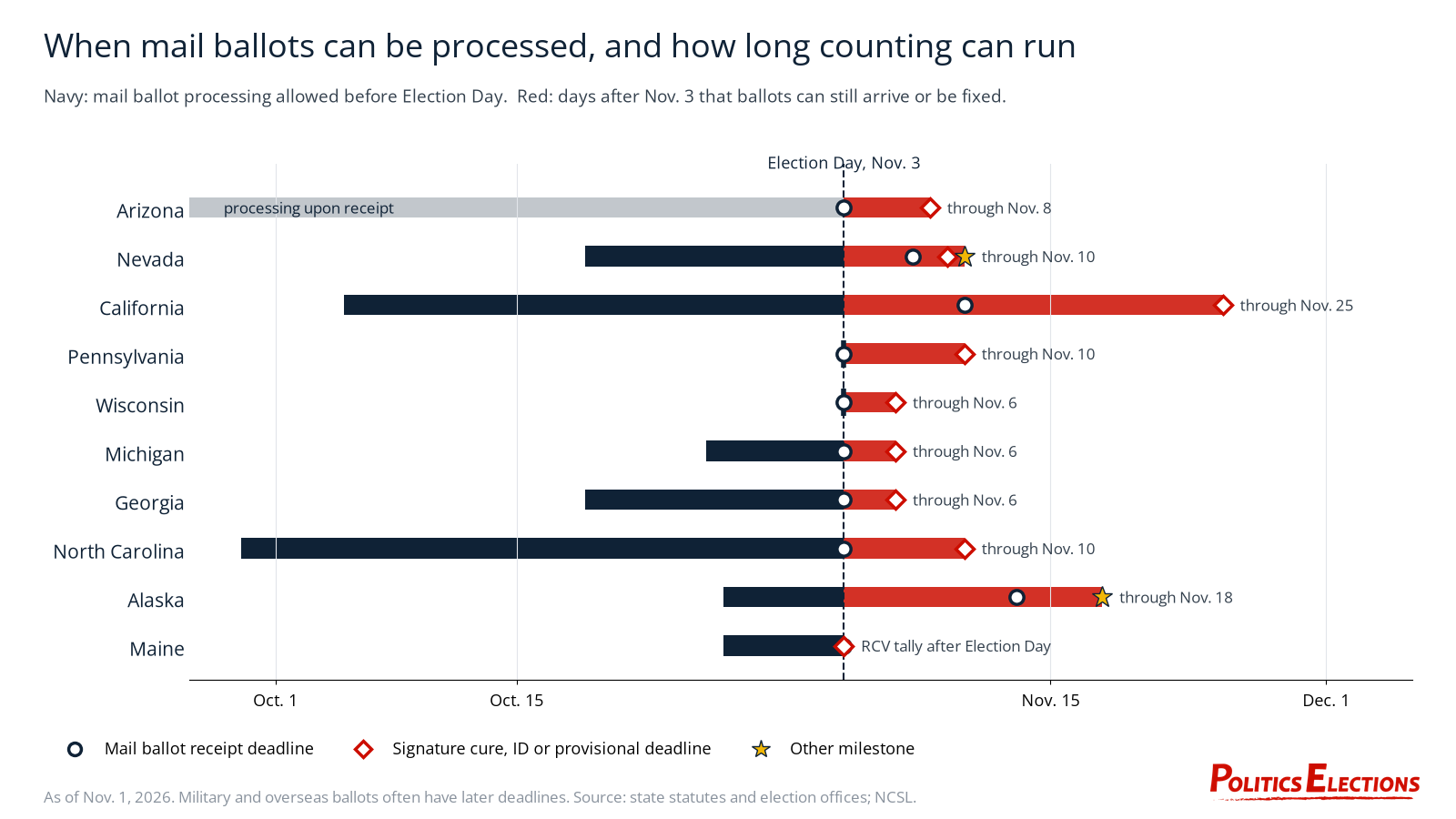
How fast a state reports depends on when it may open mail ballots, how late those ballots may arrive and how long voters get to fix problems. Here are those dates for 10 states with close races or long counts.
Updated Nov. 1, 2026. Dates checked against state statutes, state election office pages and National Conference of State Legislatures tables on Nov. 1, 2026. This is general information, not legal advice; confirm with your state or county election office.
When will election results be known after polls close on Tuesday, Nov. 3? The answer depends on the state. Some states let officials open and scan mail ballots weeks before Election Day. Others cannot start until that morning, and a few accept mail ballots that arrive days later. Every count also has to make room for signature fixes and provisional ballots, so unofficial totals keep moving after election night.
No state allows results from processed mail ballots to be released before polls close, according to the National Conference of State Legislatures. What changes from state to state is how much of that work is already done when the polls close. For poll closing times by state, see the Politics Elections guide to what time polls close on Election Day.
This guide covers 10 states: Arizona, Nevada, California, Pennsylvania, Wisconsin, Michigan, Georgia, North Carolina, Alaska and Maine. Alaska, Maine and Michigan have Senate races rated toss-ups by the Cook Political Report as of Oct. 20, and Georgia, Nevada and Wisconsin had governor’s races rated toss-ups as of Oct. 13. Politics Elections tracks the latest polls in the Senate toss-up races and the governor toss-up races.
When will election results be known in each state?
The table lists, for each state, when mail ballots can be processed, when they must arrive and the last day to fix a ballot problem or show ID. All dates are in 2026 and in local time.
| State | Mail ballot processing can start | Mail ballot must arrive | Last day to fix a signature or show ID | What it means for results |
|---|---|---|---|---|
| Arizona | Upon receipt | 7 p.m. Nov. 3 | Signature cure: 5 p.m. Nov. 8 | Counties post how many early ballots were dropped off on Election Day |
| Nevada | Counting from Oct. 19 | Postmarked by Nov. 3, received by 5 p.m. Nov. 7 | 5 p.m. Nov. 9 | Mail count must be done by Nov. 10 |
| California | When ballots are mailed, no later than Oct. 5 | Postmarked by Nov. 3, received by Nov. 10 | Signature statement: 5 p.m. Nov. 25 | Every valid ballot is counted, even in lopsided races |
| Pennsylvania | 7 a.m. Nov. 3 | 8 p.m. Nov. 3 | Counties rule on provisional ballots within 7 days | No pre-Election Day processing |
| Wisconsin | After polls open Nov. 3 | 8 p.m. Nov. 3 | Provisional ID: 4 p.m. Nov. 6 | Central count boards work through election night |
| Michigan | Oct. 26 in places with 5,000+ people; Nov. 2 elsewhere | 8 p.m. Nov. 3 | Signature cure: 5 p.m. Nov. 6 | Early tabulation can shorten the count |
| Georgia | 8 a.m. Oct. 19 | By close of polls Nov. 3 | Nov. 6 | Advance votes due to be reported on election night |
| North Carolina | Sept. 29 (scanning at board meetings) | 7:30 p.m. Nov. 3 | Noon Nov. 10 | No postmark grace period this year |
| Alaska | Review begins by Oct. 27; counting after 8 p.m. Nov. 3 | Postmarked by Nov. 3, received by Nov. 13 (overseas Nov. 18) | Not listed in NCSL cure table | Ranked-choice results Nov. 18 |
| Maine | Oct. 27, if notice was posted | Before polls close Nov. 3 | Before polls close Nov. 3 | Ranked-choice tally in Augusta if no majority |
Source: state statutes and election offices linked below; NCSL Tables 15 and 16. Military and overseas ballots often have later deadlines. Some dates are counted from the statutory rule (for example, “the fourth day following the election”).
States that process mail ballots before Election Day
Arizona lets officials begin tabulating early ballots “immediately after the envelope and completed mail affidavit are processed,” under A.R.S. 16-550. Results cannot be released until all precincts report or one hour after polls close, whichever comes first. Mail ballots must arrive by 7 p.m. on Election Day under A.R.S. 16-548. Early ballots returned at voting locations on Election Day are counted separately: A.R.S. 16-551 requires counties to post how many came in along with their last unofficial results on election night, and beginning in 2026 those delivered without ID must be signature verified. Also starting this year, A.R.S. 16-579 lets voters who drop off a ballot show ID on the spot so the ballot is “deemed ready for tabulating.” The Arizona Secretary of State lists Nov. 8 as the ballot curing deadline and Nov. 23 as the date of the official statewide canvass.
North Carolina county boards can examine returned envelopes and scan accepted ballots at meetings starting the fifth Tuesday before Election Day, but cannot print totals, under G.S. 163-234. Ballots must reach the county board “by 7:30 p.m. on Election Day,” and the State Board of Elections says the old three-day grace period for postmarked ballots is “no longer the case” (N.C. State Board of Elections). Voters who cast provisional ballots for lack of photo ID have until noon on the fifth business day after the election, Nov. 10, to bring ID to the county board, according to the State Board’s voter ID page.
Georgia lets counties begin processing absentee ballots at 8 a.m. on the third Monday before Election Day, Oct. 19, according to NCSL’s summary of O.C.G.A. 21-2-386. State law (O.C.G.A. 21-2-493) also requires advance votes to be tabulated and reported by 8 p.m. or within an hour of all polls closing, whichever is later. Absentee ballots “must arrive at your county election office by Election Day” (Georgia.gov), and provisional voters have “three days after Election Day” to resolve problems (Georgia.gov).
Michigan cities and townships with at least 5,000 people may process and tabulate absentee ballots from 7 a.m. to 8 p.m. on any of the eight days before Election Day, starting Oct. 26, and any jurisdiction may do so on Monday, Nov. 2, under MCL 168.765a. Ballots must arrive by 8 p.m. on Election Day, according to the Michigan Department of State. A voter whose envelope signature is missing or does not match can fix it “before 5 p.m. on the third day following the election,” Nov. 6, under MCL 168.766. Provisional voters have six days to show ID, the department says.
States that wait until Election Day: Pennsylvania and Wisconsin
Pennsylvania cannot begin pre-canvassing mail ballots until 7 a.m. on Election Day under 25 P.S. 3146.8. The Department of State says “nearly all mail ballots must be received by 8p.m. on Election Day” and “There is no grace period” (Pennsylvania Department of State). Under the department’s Sept. 2026 mail ballot guidance, counties that took election grants under Act 88 must pre-canvass without stopping from 7 a.m., begin canvassing at 8 p.m. and post their unofficial mail ballot count by 12:01 a.m. the next day. County boards decide on provisional ballots “within 7 days after the election,” according to the state’s provisional ballot page. The department’s results page warns that “Results of some races may not be known on election night.”
Wisconsin municipalities that use a central count may convene “any time after the opening of the polls and before 10 p.m. on election day” to count absentee ballots, under Wis. Stat. 7.52. Ballots must be delivered by 8 p.m. on Election Day under Wis. Stat. 6.87(6). Voters who cast a provisional ballot because they lacked ID have until 4 p.m. on the Friday after the election, Nov. 6, to provide it, under Wis. Stat. 6.97(3)(b).
States that accept mail ballots after Election Day
Nevada counts mail ballots postmarked by Election Day that arrive by 5 p.m. on the fourth day after, Saturday, Nov. 7, according to the Nevada Secretary of State. Ballots returned in person must be in by 7 p.m. on Election Day. Under NRS Chapter 293, voters have until 5 p.m. on the sixth day after the election, Nov. 9, to fix a signature problem, and county boards “may begin counting the received mail ballots 15 days before the day of the election” but “must complete the count of all mail ballots on or before the seventh day following the election,” Nov. 10.
California sends a ballot to every active registered voter. Mailed ballots must be “postmarked on or before Election Day and received not later than 7 days after Election Day,” Nov. 10, according to the California Secretary of State. Processing can begin the day ballots go out, no later than 29 days before Election Day, under Elections Code 15101, according to NCSL. Voters with a signature problem have until 5 p.m. on the 22nd day after a statewide election, Nov. 25, to return a signature statement, according to NCSL’s signature cure table.
All valid vote-by-mail ballots are counted in every election in California, regardless of the outcome or closeness of any race.
Alaska absentee review boards begin work no later than Oct. 27, and ballots are counted after polls close at 8 p.m. on Election Day. Ballots mailed from inside the United States count if postmarked by Nov. 3 and received by Nov. 13; ballots from overseas have until Nov. 18, according to the Alaska Division of Elections calendar. The division says results will be posted online after 9 p.m. on election night.
Ranked-choice voting in Alaska and Maine
Alaska and Maine both use ranked-choice voting, which can add a second stage to the count. In Alaska, the Division of Elections says on its results page that “Ranked Choice Voting results will not be available until November 18, 2026 once all eligible ballots are reviewed and counted.” That is the same day as the final regional count on the state calendar. The division’s target date for certification is Nov. 25.
Maine uses ranked-choice voting in general elections “ONLY for federal offices,” and only in races with more than two candidates, according to the Maine Secretary of State. If no candidate wins a majority on election night, “the ballots and memory devices from each municipality are securely transported to a central tabulation site in Augusta to begin the ranked choice tabulation process.” The Secretary of State does not give a date for that tally. Absentee ballots must reach the town clerk “before the polls are closed” under 21-A M.R.S. 755. Processing may start seven days before Election Day if notice of processing times is posted at least 30 days before the election, according to NCSL.
Runoffs in Georgia and Louisiana
In some races, the Nov. 3 count will not settle the seat. Louisiana’s U.S. House races are on the Nov. 3 open primary ballot, and the Louisiana Secretary of State says a general election, if needed, will be held Dec. 12, 2026 (Louisiana election dates). Georgia also uses runoffs in general elections when no candidate reaches the required majority. Politics Elections explains how each state’s rules work in its guide to runoff elections by state.
After the count: certification
Election-night totals are unofficial. Each state has its own deadlines for counties to canvass and for the state to certify, which Politics Elections lists in its guide to election results certification deadlines by state. Very close margins can also trigger recounts under separate state rules.
About these numbers
Dates come from state statutes, state election office pages and NCSL Tables 15 and 16, all read Nov. 1, 2026. Where a law sets a deadline as a number of days after the election, Politics Elections counted from Tuesday, Nov. 3. Arizona’s curing deadline is 5 p.m. Sunday, Nov. 8, according to the Secretary of State. The codified text of A.R.S. 16-550 still says the fifth business day, but a 2024 law (HB 2785) set the fifth calendar day for elections held in 2024 through 2026, according to NCSL’s cure table. Georgia’s processing start and Maine’s early processing rule come from NCSL summaries of state law. Deadlines shown are for mail ballots sent from inside the United States; military and overseas voters often have more time. Courts or state officials can change procedures, and counties report on their own schedules. Voters should confirm deadlines with their state or county election office.