Democrats flipped seven Republican-held Senate seats on Nov. 3 and will control the chamber in January, according to race calls by The Associated Press. No Democratic-held seat flipped. Alaska and Mississippi are not yet called. Here is where the map moved and by how much.
Updated Nov. 4, 2026, 12:30 p.m. ET. All 2026 figures are unofficial and not certified. Results are from NPR’s tally of Associated Press data as of 11:55 a.m. ET Nov. 4 (latest race update 11:54 a.m. ET). A race counts as won only where the AP has called it.
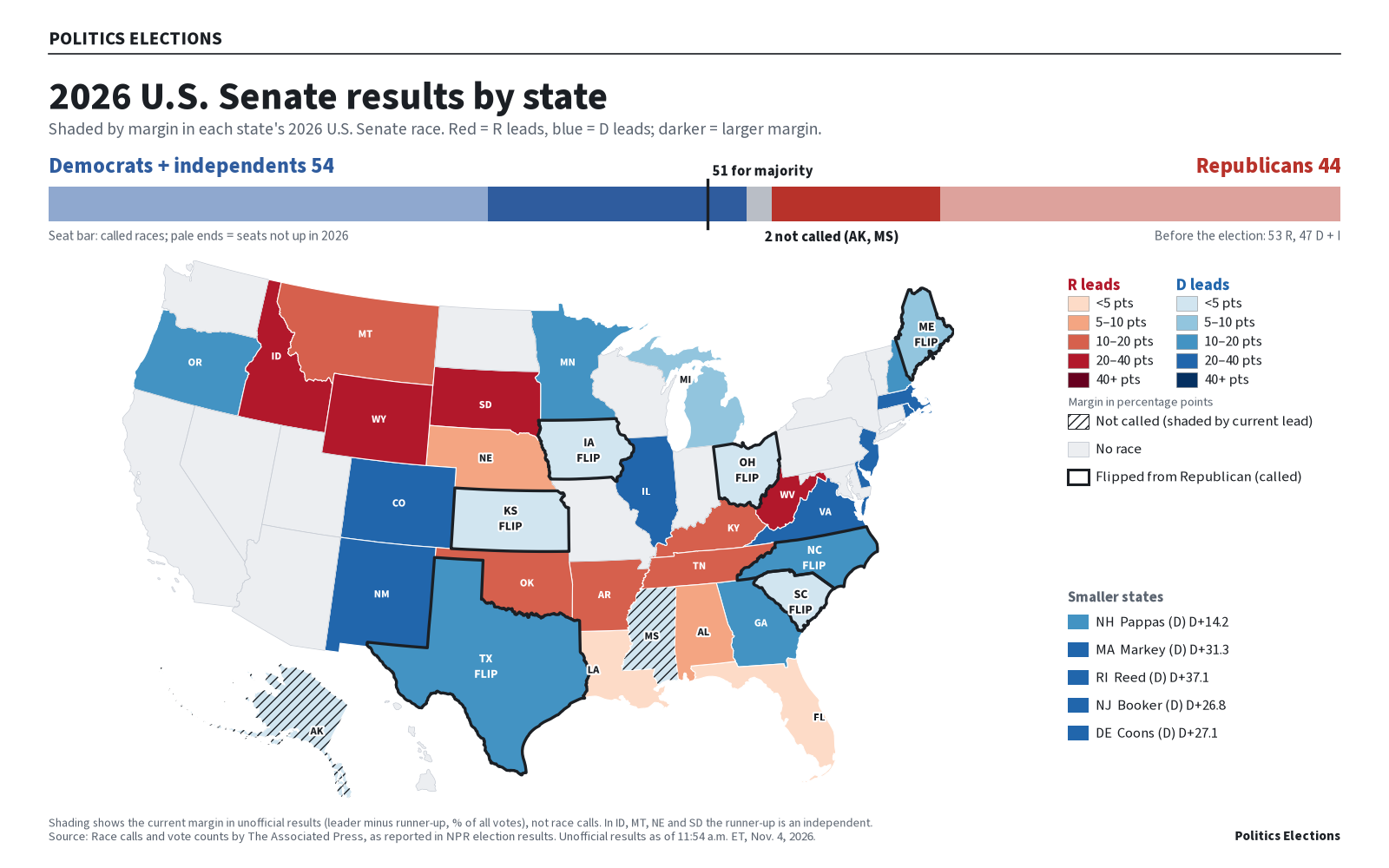
The 2026 Senate results give Democrats control of the chamber. NBC News projects Democrats win control, and NPR reported that “Democrats have cemented control of both chambers of Congress,” based on its tally of Associated Press race calls. The AP’s headline reads: “Democrats win the US House and Senate as voters deliver a strong rebuke to Trump and Republicans.”
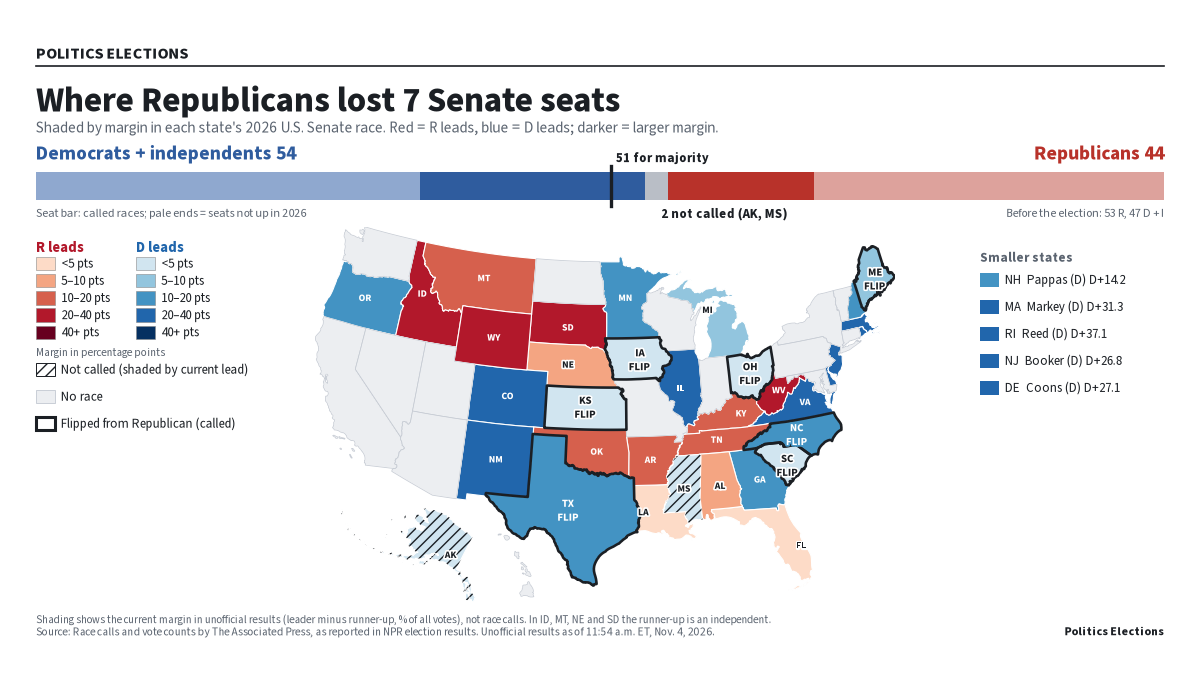
With two races not yet called, the Democratic caucus holds 54 seats: 52 Democrats and two independents who caucus with them, Sens. Bernie Sanders and Angus King. Republicans hold 44. Republicans went into the election with a 53-47 majority. NBC News reported that Democrats “needed a net gain of four seats to reclaim control of the chamber.”
Outright control takes 51 seats, because Vice President JD Vance, a Republican, breaks ties in a 50-50 Senate. Both uncalled seats are held by Republicans. If Republicans won both, they would have 46 seats, still short of a majority.
Seven Republican-held seats flipped
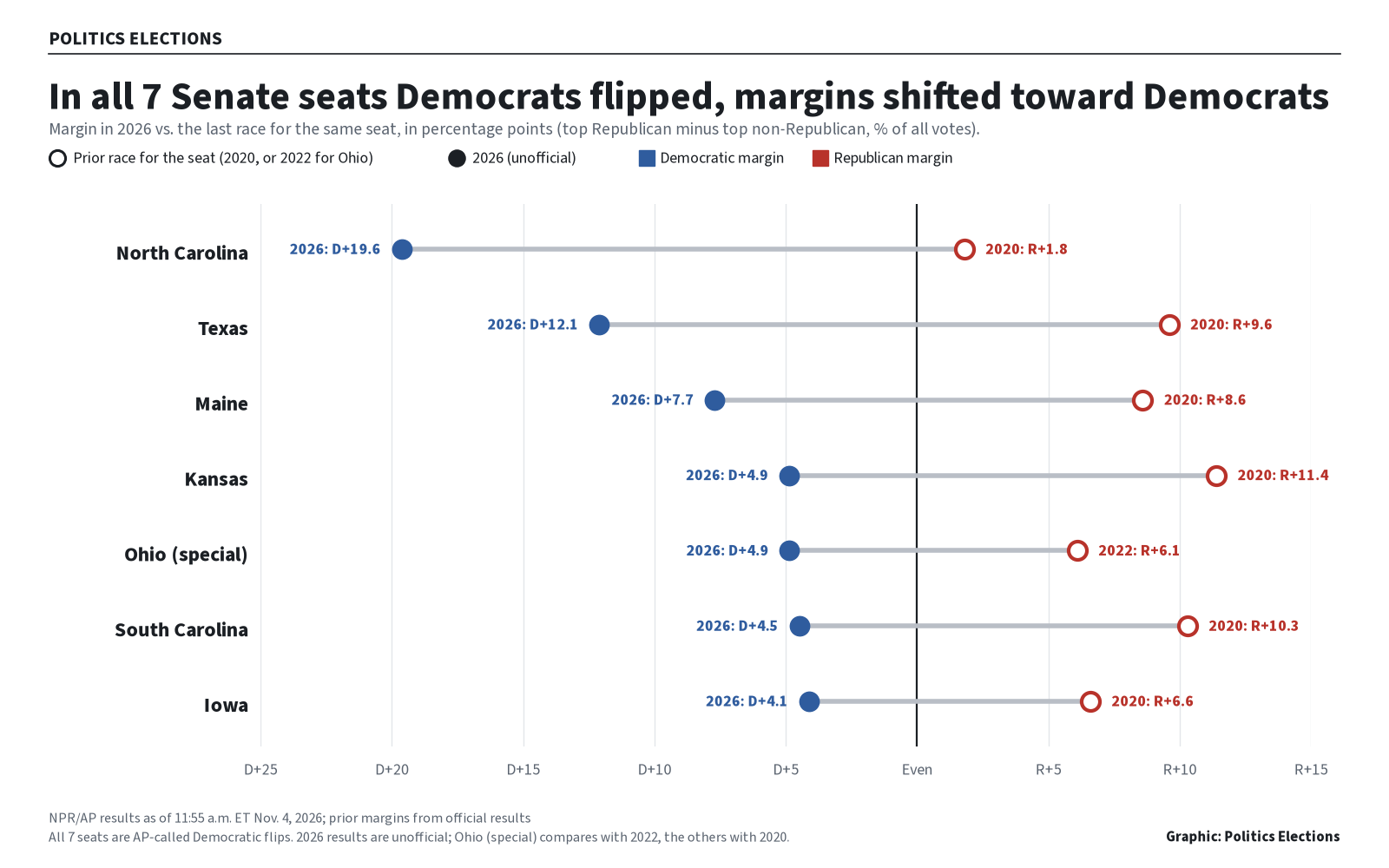
Democrats posted a net gain of seven seats. The AP called seven Republican-held seats for Democrats and no Democratic-held seat for a Republican. NPR lists the same seven: North Carolina, South Carolina, Ohio, Texas, Kansas, Iowa and Maine. The table compares each 2026 margin with the last time the same seat was on the ballot.
| State | Winner (D) | Defeated (R) | 2026 margin | Same seat last time | Shift |
|---|---|---|---|---|---|
| Texas | James Talarico, 55.1% | Ken Paxton, 43.0% | D+12.1 | 2020: R+9.6 | 21.7 pts toward D |
| North Carolina | Roy Cooper, 58.7% | Michael Whatley, 39.1% | D+19.6 | 2020: R+1.8 | 21.4 pts toward D |
| Maine | Troy Jackson, 53.8% | Sen. Susan Collins, 46.1% | D+7.7 | 2020: R+8.6 | 16.3 pts toward D |
| Kansas | Adam Hamilton, 50.9% | Sen. Roger Marshall, 46.1% | D+4.9 | 2020: R+11.4 | 16.3 pts toward D |
| South Carolina | Annie Andrews, 51.1% | Sen. Darline Graham, 46.7% | D+4.5 | 2020: R+10.3 | 14.8 pts toward D |
| Ohio (special) | Sherrod Brown, 50.0% | Sen. Jon Husted, 45.2% | D+4.9 | 2022: R+6.1 | 11.0 pts toward D |
| Iowa | Josh Turek, 50.5% | Ashley Hinson, 46.4% | D+4.1 | 2020: R+6.6 | 10.7 pts toward D |
Swipe to see more →
Texas. State Rep. James Talarico defeated state Attorney General Ken Paxton, 55.1% to 43.0%, with an estimated 98% of the expected vote counted, according to NPR’s tally. That is a 22-point swing from the seat’s 2020 result.
North Carolina. Democrat Roy Cooper beat Republican Michael Whatley by 19.6 points, the widest margin among the seven flips. Republicans won the seat by 1.8 points in 2020.
Maine and Kansas. Two Republican incumbents lost. Troy Jackson unseated Sen. Susan Collins by 7.7 points with an estimated 89% counted. In Kansas, Adam Hamilton defeated Sen. Roger Marshall by 4.9 points. NBC News said the Kansas race “has shifted 20.99 points toward Democrats compared with the 2024 presidential election,” in a state it noted President Trump carried by 16 points in 2024.
South Carolina. Pediatrician Annie Andrews defeated Sen. Darline Graham, 51.1% to 46.7%. Graham was appointed to the seat after the death of her brother, longtime Sen. Lindsey Graham, NPR reported. NBC News noted the state had not sent a Democrat to the Senate since 1998.
Ohio and Iowa. Democrat Sherrod Brown beat Sen. Jon Husted in the Ohio special election, 50.0% to 45.2%. In Iowa, Josh Turek defeated Republican Ashley Hinson by 4.1 points for a seat Republicans won by 6.6 points in 2020.
How far the map moved toward Democrats
Thirty-one of the 35 seats on the ballot moved toward Democrats compared with the last time each seat was up, based on unofficial 2026 margins and certified prior results. Among races with a Republican and a Democrat as the top two in both cycles, the biggest moves were in West Virginia (22.9 points, from R+43.3 to R+20.4), Texas (21.7), North Carolina (21.4), New Mexico (20.2), Georgia (16.8), Maine and Kansas (16.3 each) and Wyoming (15.7).
Four seats moved slightly toward Republicans: New Hampshire (1.5 points), Oregon (1.6), Massachusetts (1.9) and Montana (1.9). Democrats still held New Hampshire, Oregon and Massachusetts comfortably, and Republicans held Montana.
Some comparisons are not like-for-like. Louisiana’s 2020 race was an all-party primary, and Arkansas had no Democratic nominee in 2020. In Idaho, Montana, Nebraska and South Dakota, the main 2026 challenger was an independent. Counting is also incomplete in several states, so margins and shifts can still move.
Where Republicans held on
Republicans won 13 called races. The closest was Louisiana, where Julia Letlow beat Democrat Jamie Davis 50.9% to 49.1%. In the Florida special election, Republican Ashley Moody defeated Democrat Angie Nixon by 2.9 points, a seat Republicans won by 16.4 points in 2022. In Nebraska, Republican Pete Ricketts held off independent Dan Osborn, 370,411 votes to 321,218 in the unofficial count.
Other Republican holds included Alabama (Barry Moore, R+9.4), Arkansas (Tom Cotton, R+11.9), Kentucky (Andy Barr, R+12.1), Tennessee (Bill Hagerty, R+12.2), Montana (Kurt Alme, R+11.9) and Oklahoma (Kevin Hern, R+18.1).
Democrats held all of their seats on the ballot. In Michigan, Abdul El-Sayed beat Republican Mike Rogers by 7.1 points. Jon Ossoff held Georgia by 18.0 points, and Peggy Flanagan held Minnesota by 10.2 points.
Not yet called: Alaska and Mississippi
Alaska is not yet called. With an estimated 74% of the expected vote counted, Democrat Mary Peltola had 102,701 votes (48.2%) and Republican Dan Sullivan had 102,075 (47.9%), a gap of 626 votes. Alaska uses ranked-choice voting.
Mississippi is not yet called. With an estimated 96% counted, Democrat Scott Colom had 462,821 votes and Republican Cindy Hyde-Smith had 462,778, a gap of 43 votes. Each had 48.9%.
What’s next
Two races are not yet called. In Alaska, absentee ballots mailed from inside the U.S. must arrive by Nov. 13, and overseas ballots are due by Nov. 18, according to the Alaska Division of Elections. That day, the Division checks whether any candidate has a majority of the vote and, if not, runs its ranked-choice tabulation. The state’s target date to certify results is Nov. 25. In Mississippi, county election commissions must send certified returns to the Secretary of State by Nov. 13, and the Secretary of State’s 2026 elections calendar sets Dec. 3 for declaring the results.
Counting continues elsewhere, too. Several states had counted less than 90% of the expected vote as of this update, including Alaska (74%), Oregon (75%), Colorado (77%) and Maine (89%). Under the 20th Amendment to the U.S. Constitution, terms of the new Congress begin Jan. 3, 2027. All 2026 numbers stay unofficial until states certify their results. For the other chamber, see our 2026 House postmortem.
Sources: race calls by The Associated Press and unofficial vote counts as reported in NPR election results, as of 11:55 a.m. ET Nov. 4, 2026; control projections and reporting from NBC News, NPR and the AP; prior-cycle margins from certified 2020 and 2022 Senate results. Margins and shifts were calculated by Politics Elections.