Funding dates are from P.L. 119-103, Division A, section 106. The bill status is from the Congressional Research Service FY2027 Appropriations Status Table, last updated Nov. 17, 2026. Checked at 6:45 AM ET, Nov. 26, 2026.
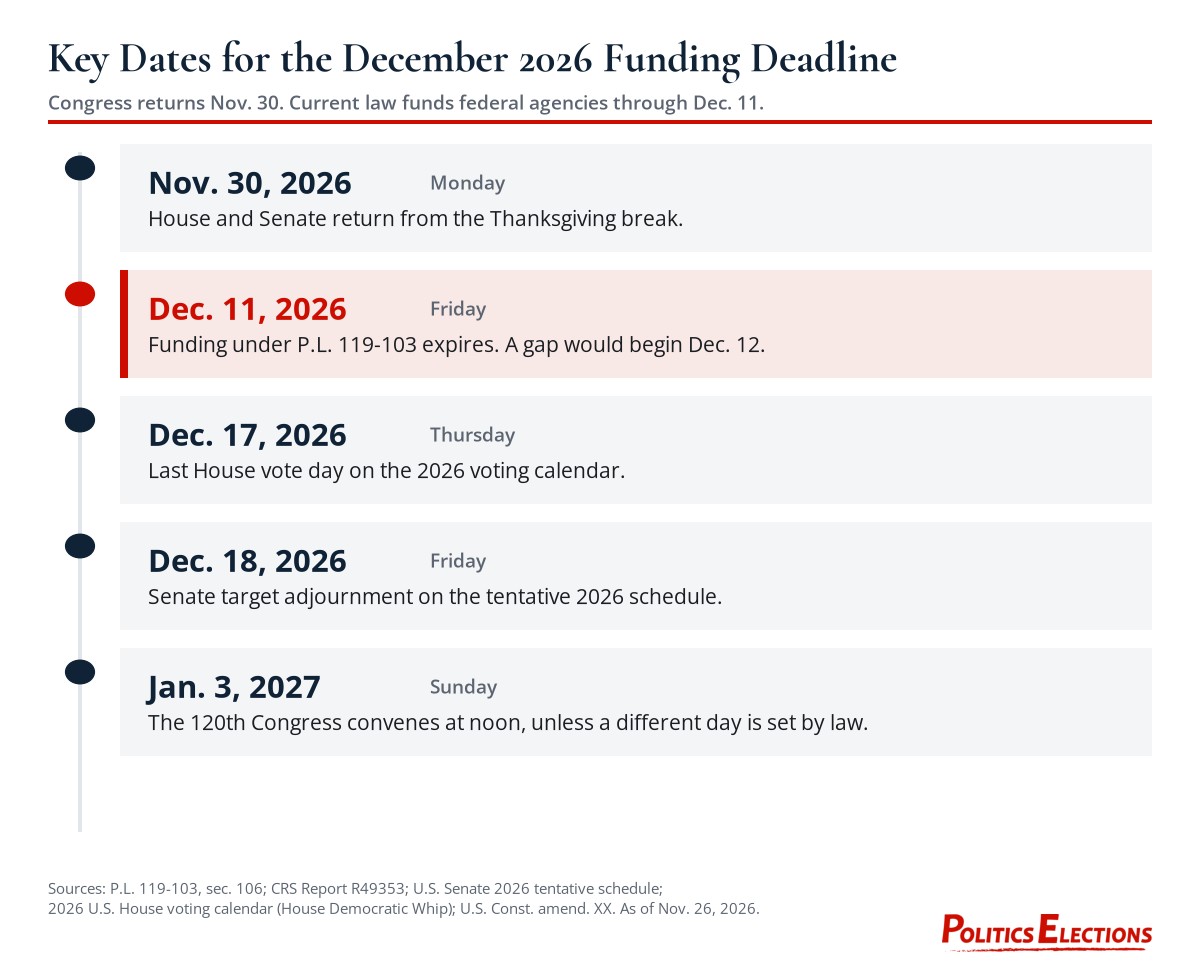
The federal government is funded through Dec. 11, 2026, under a continuing resolution President Donald Trump signed on Sept. 2. If Congress does not enact full-year appropriations or another temporary funding bill, a funding gap would begin Dec. 12, the Congressional Research Service has said. That government shutdown December 2026 deadline is the first hard funding vote Congress faces when it returns from the Thanksgiving break.
Both the House and the Senate are scheduled to resume business on Monday, Nov. 30. The Senate returns at 3 p.m. ET, the Senate Daily Press Gallery recorded on Nov. 24. The House has a Rules Committee meeting scheduled that afternoon, according to House.gov.
The government shutdown December 2026 deadline
The current law is P.L. 119-103, officially the Continuing Appropriations and Extensions Act, 2027, enacted as H.R. 6500. Division A keeps most federal agencies operating at fiscal 2026 rates through Dec. 11, or earlier if Congress and the president enact the applicable appropriations bill.
Section 106 of the law says the money and authority remain available until the first of three events: enactment of an appropriation for the activity, enactment of the applicable fiscal 2027 appropriations act without funding for it, or Dec. 11, 2026.
CRS describes the measure as a 72-day continuing resolution covering roughly the first 10 weeks of fiscal 2027, which began Oct. 1. Congress has to act before that expiration “to avoid a funding gap beginning on December 12, 2026, that may result in a shutdown of affected government activities,” the CRS overview of the law says.
The Senate passed the continuing resolution 90-6, and the House agreed to the Senate amendments 370-48 on Sept. 1, according to the CRS status table. Trump signed the measure the next day.
When does government funding run out? Under current law, it runs out on Dec. 11 unless a new appropriations act or another continuing resolution is enacted first.
Full-year bills or another continuing resolution
Congress has two basic options: finish the 12 regular fiscal 2027 appropriations bills, or pass another short-term continuing resolution.
The House Appropriations Committee reported all 12 bills by late June, the CRS table shows. The House has passed three of them:
- Military Construction, Veterans Affairs, and Related Agencies (H.R. 8469), 400-15, on May 15.
- Agriculture, 213-210, on June 4.
- National Security, Department of State, and Related Programs (H.R. 8595), 217-209, on July 15.
The other nine House bills, including Defense and Homeland Security, have cleared committee but had not received a House floor vote as of the Nov. 17 CRS update. None of the 12 regular bills has passed the Senate. In November, the Senate Appropriations Committee posted draft text and summaries for all 12 measures, the CRS table notes.
| Measure | Status as of the Nov. 17 CRS update |
|---|---|
| All 12 House appropriations bills | Reported by the House Appropriations Committee |
| House floor passage | 3 of 12 (Military Construction-VA, Agriculture, and National Security-State) |
| Senate regular bills | Drafts of all 12 posted; none passed the Senate |
| Current continuing resolution (P.L. 119-103) | Funds agencies through Dec. 11, 2026 |
From the Congressional Research Service FY2027 Appropriations Status Table, last updated Nov. 17, 2026, and P.L. 119-103, section 106.
House Appropriations Chairman Tom Cole of Oklahoma, in a Nov. 18 committee statement after those Senate drafts were released, said the two chambers now have what they need to negotiate.
“A lame duck doesn’t have to leave full-year bills dead in the water. I’ve been actively working with my counterparts to advance negotiations, avoid an unnecessary shutdown, and get full-year FY27 legislation signed into law.”
“I’m ready and determined to move as many full-year FY27 bills as possible before the end of the year.”
Cole also said, “With all twelve Senate bills now public and the House measures long on the table, we have what we need to negotiate in earnest.”
The White House has sent appropriators a list of “anomalies,” or exceptions it wants written into a new continuing resolution. The list, published by Punchbowl News and titled “FY 2027 Continuing Resolution (CR) Appropriations Issues,” requests a $5.0 billion higher rate of operations for the Golden Dome missile-defense program and an additional $2 billion for NASA’s Artemis program, among other items. Punchbowl reported that the list assumes a continuing resolution running through March 31. The document itself is a request, not enacted funding, and it states that additional Department of War anomalies are forthcoming.
Punchbowl also reported that some Senate Democrats have informally discussed language to cut off funding for U.S. offensive operations in Iran. No such restriction has been enacted, and no vote on that language has been scheduled.
This article is limited to the Dec. 11 funding deadline. Other measures still pending in this lame-duck session of Congress include the National Defense Authorization Act for Fiscal Year 2027. The House passed that bill, H.R. 8800, 216-212 on July 22, according to a CRS status report updated Sept. 1. In the Senate, cloture on the motion to proceed to S. 4784 failed 50-46 on July 14. The Senate’s cloture list for the 119th Congress, checked Nov. 26, shows no later cloture vote on the measure. The NDAA authorizes defense policy. It does not, by itself, fund the government past Dec. 11.
In the Senate, a funding bill can require 60 votes to end debate under the chamber’s filibuster rules. The current continuing resolution cleared that bar, 90-6.
The calendar when Congress returns
The 2026 U.S. House voting calendar published by the House Democratic Whip marks 12 remaining vote days from Nov. 30 through Dec. 17, the last day currently marked for votes: Nov. 30; Dec. 1, 2 and 3; Dec. 8 through 11; and Dec. 14 through 17. The Senate’s tentative 2026 schedule lists a target adjournment of Dec. 18, with a state work period beginning Dec. 21.
That leaves a short window after Dec. 11. If a funding bill has not become law by then, the lapse would already have begun. The calendars can still change.
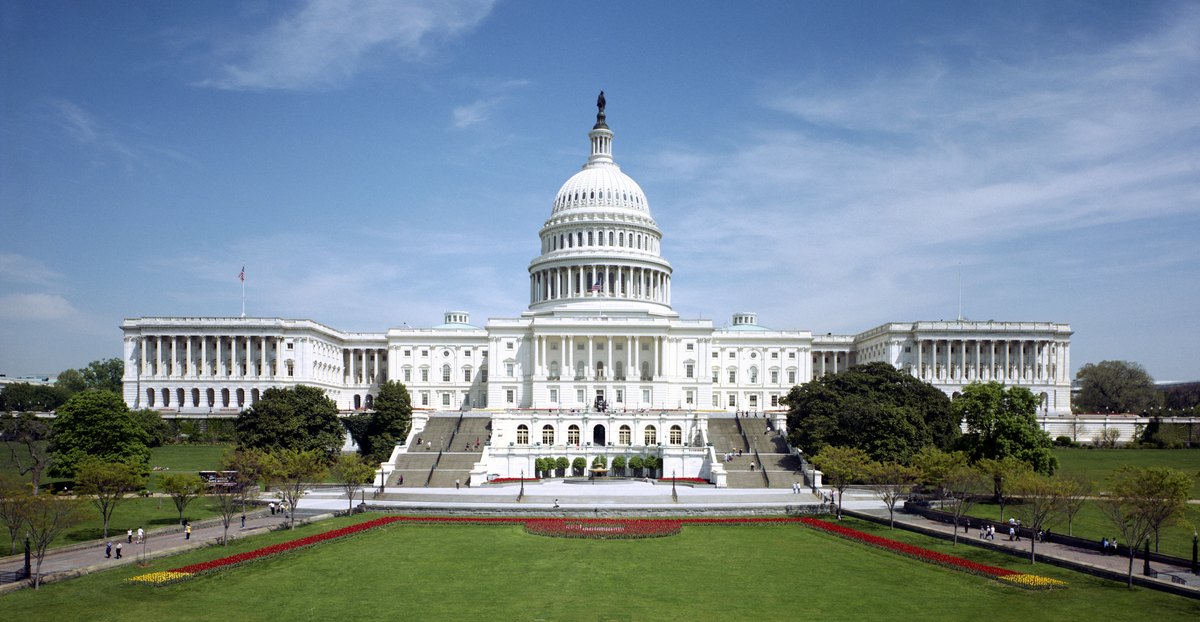
The 120th Congress is set to convene at noon on Jan. 3, 2027, unless Congress sets another day by law, as the 20th Amendment provides and as House.gov notes.
What a shutdown would and would not close
A lapse does not automatically close every federal function. The Antideficiency Act generally bars agencies from spending or obligating money without an appropriation, with limited exceptions, OMB’s Jan. 30, 2026, FAQ on a lapse in appropriations explains.
Agencies may continue “excepted” work when a statute authorizes obligations in advance of appropriations, when stopping the work would imminently threaten the safety of human life or the protection of property, or when the work is necessary to the president’s constitutional duties. OMB also says agencies may continue administrative work that is “necessarily implied” by funded activities, including the work needed to send entitlement benefits such as Social Security payments, which are funded by a permanent indefinite appropriation.
Employees who are not needed for excepted work are furloughed. Excepted employees who work during a lapse are paid after Congress enacts appropriations, the same FAQ says. Agency websites may be shut down or run with reduced updates unless they are needed for excepted or funded work.
Each agency keeps its own contingency plan, posted on the agency’s website under OMB Circular A-11. Those plans, not the calendar, would govern which offices stay open if funding lapses.