Cook Political Report rates seven Senate contests as toss-ups, and the newest public polls in Alaska, Iowa, Kansas, Maine, Michigan, Ohio and Texas show every margin at 4 points or less.
Data as of Oct. 20, 2026, 6:54 PM ET (ratings and polls last checked). Cook ratings dated Oct. 20; poll field dates listed with each result.
Seven Senate toss-up races could decide control of the chamber on Nov. 3, according to the Cook Political Report’s Oct. 20 ratings. Six of the seven seats are held by Republicans: Alaska, Iowa, Kansas, Maine, Ohio and Texas. The seventh, Michigan, is held by Democrats.
Republicans hold 53 seats in the current Senate to 45 Democrats and two independents who caucus with Democrats, according to the Senate Historical Office. With Vice President JD Vance able to break a 50-50 tie, Democrats would need a net gain of four seats to win a majority.
Every poll below is the pollster’s own published result among likely voters, with field dates.
Texas
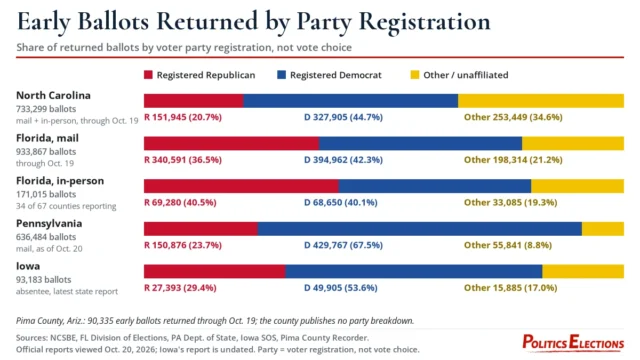
In the open race between Republican Ken Paxton and Democrat James Talarico, the University of Houston Hobby School survey of 2,000 likely voters, fielded Oct. 10–14, found Talarico at 48% and Paxton at 46%, within the ±2.19-point margin of error. An InsiderAdvantage survey of 1,200 likely voters conducted Oct. 13–14 had Paxton ahead, 49% to 48%. Texas early voting began Oct. 19.
Ohio
Sen. Jon Husted, appointed by Gov. Mike DeWine to the seat JD Vance vacated, faces former Democratic Sen. Sherrod Brown in a special election for the remaining two years of the term. Rasmussen Reports found Husted ahead 49% to 47% among 901 likely voters surveyed Oct. 12–14, after Brown led 46% to 43% in September. The Marist Poll, fielded Oct. 15–18, had Brown ahead 48% to 44% among likely voters, with a ±4.5-point margin of error.
Iowa
In the open seat, Republican Ashley Hinson led Democrat Josh Turek 48% to 45% in a co/efficient survey of 863 likely voters fielded Oct. 15–19. Emerson College Polling had Hinson ahead 47% to 45% on Oct. 5–6. The Marist Poll, fielded Oct. 8–11, showed Turek at 48% and Hinson at 45% among likely voters, with a ±6.6-point margin.
Kansas
Republican Sen. Roger Marshall led Democrat Adam Hamilton 48% to 47% in the same Oct. 13–14 InsiderAdvantage series. An earlier InsiderAdvantage poll, conducted Oct. 9–10, had Hamilton up 48% to 47%.
Maine
Republican Sen. Susan Collins, a five-term senator first elected in 1996, trails Democrat Troy Jackson, a former state Senate president, 49% to 47% in a Suffolk University poll of 500 likely voters fielded Oct. 8–11, with a ±4.4-point margin. Suffolk found Collins ahead 47% to 44% among independents. InsiderAdvantage’s Oct. 13–14 survey also had Jackson ahead, 49% to 47%.
Alaska
Alaska uses ranked-choice voting, and four names are on the Senate ballot. Rasmussen Reports found Democrat Mary Peltola at 44% and Republican Sen. Dan S. Sullivan at 42% in first choices among 775 likely voters surveyed Oct. 12–15. Republican Gerald Heikes drew 4% and Daniel J. Sullivan 3%. InsiderAdvantage’s Oct. 9–10 poll showed Peltola ahead 50% to 48% after ranked-choice reallocation.
Michigan
In the only Democratic-held toss-up, Democrat Abdul El-Sayed led former Republican Rep. Mike Rogers 46% to 44% among 798 likely voters in a Rasmussen Reports poll conducted Oct. 12–14. InsiderAdvantage’s Oct. 9–10 survey had El-Sayed ahead 48% to 46%.
Analysis
Republicans can absorb a net loss of three seats and keep the majority with the vice president’s tie-breaking vote. Of the seven toss-ups, Republicans lead or tie in at least one recent poll in Texas, Ohio, Iowa and Kansas, and the margin in all seven is 4 points or less in the newest surveys listed here. InsiderAdvantage pollster Matt Towery wrote that senior voters “are breaking GOP in most states by wide margins, with Maine being the exception.” With most of these leads inside the margin of error, turnout will be key to which party wins the majority.
Related: 4 Governor Toss-Up Races Show 1- to 7-Point Margins in Latest Polls | 6 States Decide Voter ID Ballot Measures on Nov. 3 | Southwest Border Apprehensions Fall to 98,708 in Fiscal 2026 | Early Voting Numbers: 2.6 Million Ballots in 4 States, Pima County