Voters in six states will decide whether to write voter ID into their constitutions as courts, the Justice Department and state election offices fight over voter rolls two weeks before the midterms.
Data as of Oct. 20, 2026, 6 PM ET
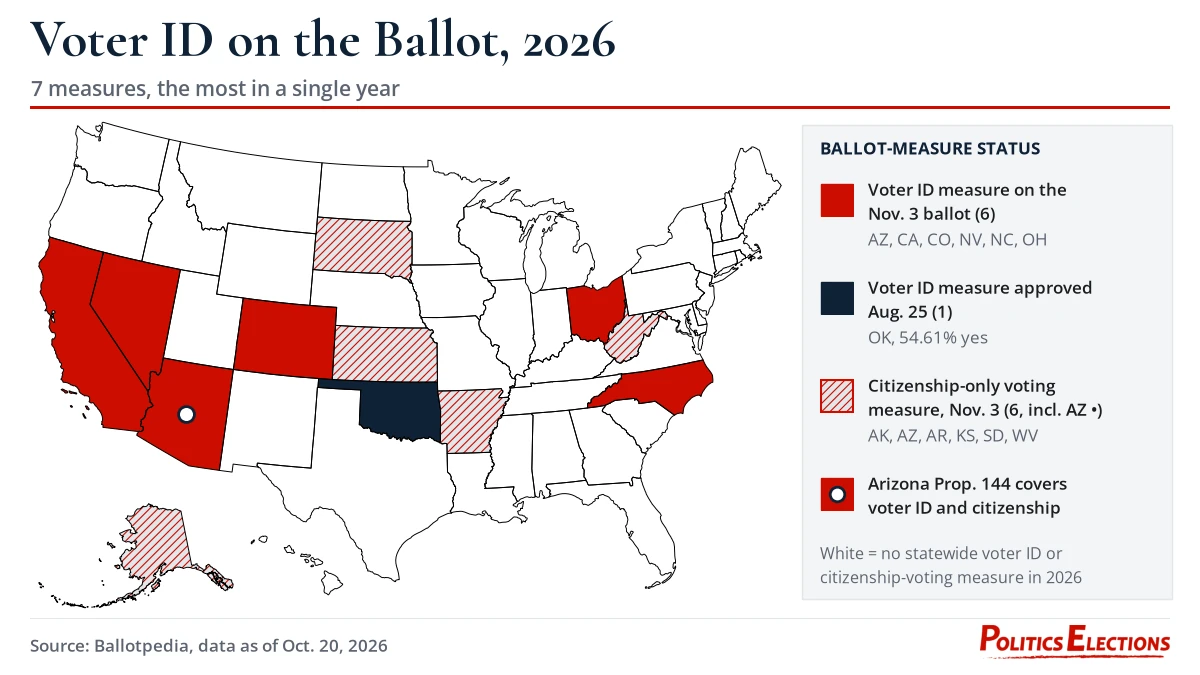
Voter ID ballot measures will appear on the Nov. 3 ballot in Arizona, California, Colorado, Nevada, North Carolina and Ohio. According to Ballotpedia’s 2026 voter ID tracker, voters will decide seven statewide voter ID measures in 2026, the most in any single year. The previous high was three, in 2022.
Oklahoma voters already acted. State Question 846, which puts a proof-of-identity requirement for in-person and mail voting into the state constitution, passed on Aug. 25 with 54.61% of the vote.
What the six November measures would do
Each would amend a state constitution, and none would loosen an existing requirement.
- Nevada Question 7 would require photo ID to vote in person. Mail voters would verify their identity with the last four digits of a driver’s license or Social Security number, or a number issued by the county clerk. Nevada requires a constitutional initiative to pass twice. Voters approved Question 7 in 2024 by 73.23% to 26.77%, and a second yes vote would put it into effect.
- California Proposition 39, a citizen initiative, would require government-issued ID at the polls and the last four digits of a designated ID number on mail ballots. It would also direct officials to verify registered voters’ citizenship and require the state to provide free ID. California and Nevada are the only two of the seven states that do not currently require voter ID.
- Arizona Proposition 144, referred by the Legislature, would require government-issued ID in person and by mail and state that only U.S. citizens may register and vote.
- North Carolina’s legislatively referred amendment would require photo ID for both in-person and mail voting.
- Ohio Issue 3 would place the state’s photo ID requirement in the constitution and add ID rules for mail voting.
- Colorado Amendment 84, a citizen initiative, would require mail voters to provide a signature plus either a REAL ID-compliant state ID number or a Social Security number.
Separately, Ballotpedia lists six measures in Alaska, Arizona, Arkansas, Kansas, South Dakota and West Virginia that would provide that only U.S. citizens may vote in state and local elections.
Supreme Court lets late-arriving mail ballots count
In Watson v. Republican National Committee, decided June 29, the U.S. Supreme Court ruled 5-4 that federal election-day statutes do not bar Mississippi from counting absentee ballots postmarked by Election Day and received up to five business days later. The opinion notes that roughly 30 states count at least some ballots that arrive after Election Day.
Justice Department sues California over voter list
On Oct. 15, the U.S. Department of Justice sued California, saying that a review with the Department of Homeland Security found “more than 20,000 people who are likely aliens are registered to vote in California.” California mails every registered voter a ballot.
“State-facilitated voter fraud is unacceptable in the United States of America,” Attorney General Todd Blanche said in the release. DHS Secretary Markwayne Mullin said “even one noncitizen vote cancels out the ballot of an American citizen.” Federal prosecutors said California officials refused to remove the registrants or set aside their returned ballots. It is not the department’s first suit against the state over immigration: in March 2018 it sued California over its sanctuary laws, a case Orange County, several of its cities and then-Rep. Dana Rohrabacher rallied behind.
The suit is part of a broader push. The Justice Department has filed 31 lawsuits, against 30 states and the District of Columbia, seeking complete voter registration lists, according to a University of Wisconsin Law School tracker updated Oct. 20. District courts have dismissed 26, Oklahoma settled by agreeing to provide its data, and cases against Delaware, Hawaii, Idaho and Utah remain pending.
On Oct. 9, U.S. District Judge Sparkle L. Sooknanan in Washington, D.C., vacated what the court called the department’s Voter List Maintenance Policy, ruling for Common Cause. The department is appealing to the D.C. Circuit and asked for a stay, writing: “There is no such policy.”
States clean their own rolls
The Texas Secretary of State reported on Sept. 15 that running the state’s 18 million registered voters through the federal SAVE database flagged 2,724 potential noncitizens. A manual review found 578 had shown citizenship, 506 of them because passport data was added to SAVE after the first run, and the office referred 117 cases to the Attorney General for investigation.
In Ohio, Secretary of State Frank LaRose announced on Sept. 9 that 75 more noncitizen registrations had been removed, according to his office’s release as reprinted by The Highland County Press. On Sept. 21 his office published a list of 208,856 inactive registrations scheduled for removal in January 2027 under the state’s routine maintenance program, according to Ohio Secretary of State figures reported by WOSU.
Analysis: what to watch on Nov. 3
California and Nevada carry the most weight, as the two states on the list without a voter ID law today. Elsewhere, the measures would write voter ID into state constitutions, in several states extending it to mail voting, so a future legislature could not repeal it without another statewide vote.
Related: 7 Senate Toss-Up Races, 6 Held by Republicans, Two Weeks Out | 4 Governor Toss-Up Races Show 1- to 7-Point Margins in Latest Polls | Southwest Border Apprehensions Fall to 98,708 in Fiscal 2026 | Early Voting Numbers: 2.6 Million Ballots in 4 States, Pima County