From the Rio Grande Valley to the Panhandle, all 254 Texas counties shifted toward Democrats compared with 2024. Here is where the ground moved most, what happened to every statewide race and what a Democratic governor faces in the Texas House and Senate.
Updated Nov. 4, 2026, 12:45 p.m. ET. Results are unofficial as of 11:48 a.m. ET, from the Texas Secretary of State, with results from all 254 counties, some partial. AP race calls were checked at 11:52 a.m. ET; NBC News projections were checked from 9:19 to 9:54 a.m. ET.
Democrat James Talarico won Texas’ U.S. Senate race over Republican Ken Paxton, the Associated Press called, and NBC News also projects Talarico the winner. That flips the seat from Republican to Democratic. Democrats also led every other statewide race with reliable figures, according to unofficial Texas Secretary of State results.
So did Republicans hold the Senate seat in Texas? No. And nationally, NBC News projects that Democrats win control of both the U.S. Senate and the U.S. House. This look at the Texas election results walks through the county map, the statewide trend since 2020, the statewide candidates, the House delegation, the Senate and the Texas Legislature, and what a divided Capitol could mean.
County shift map: every Texas county moved toward Democrats
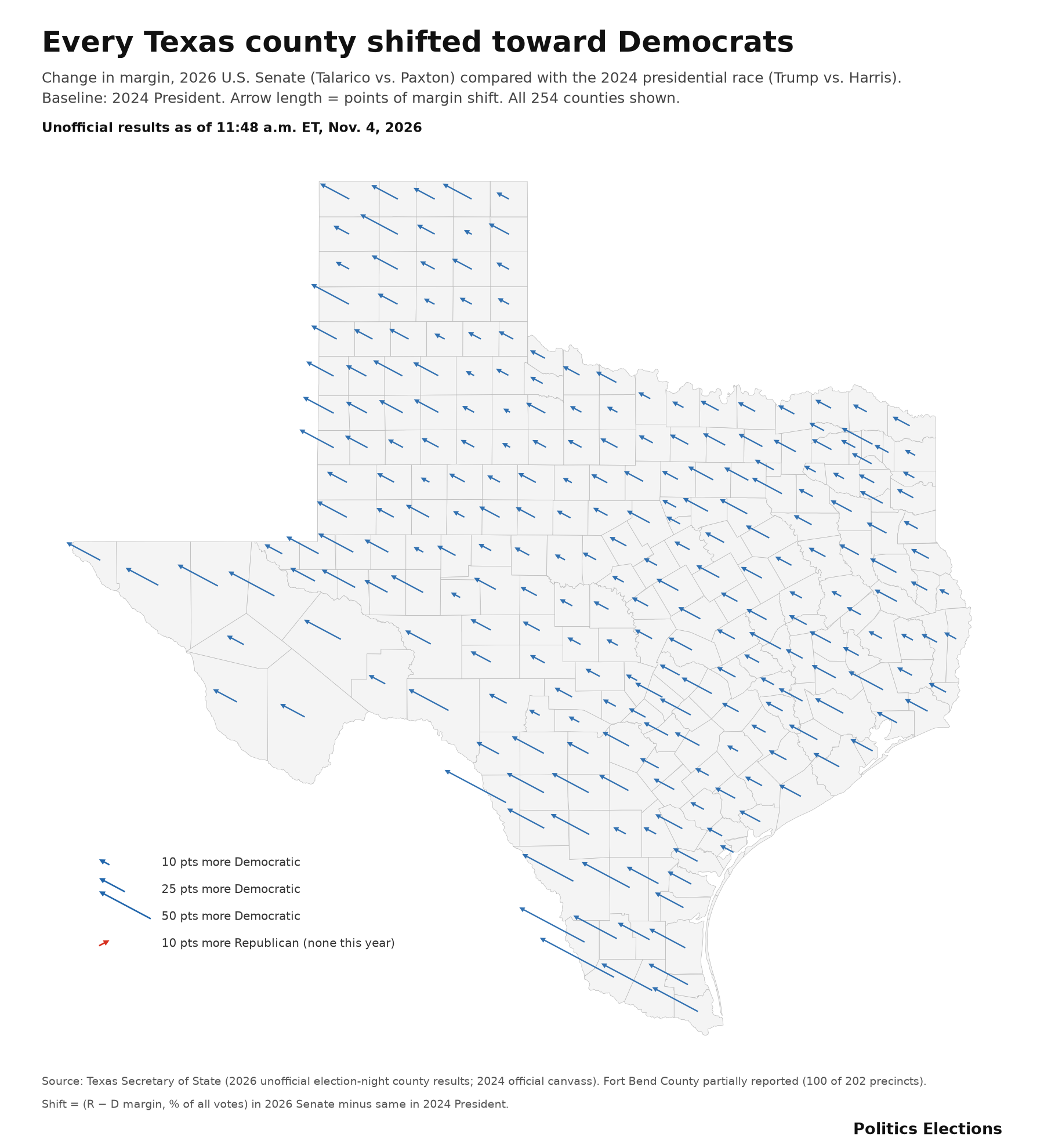
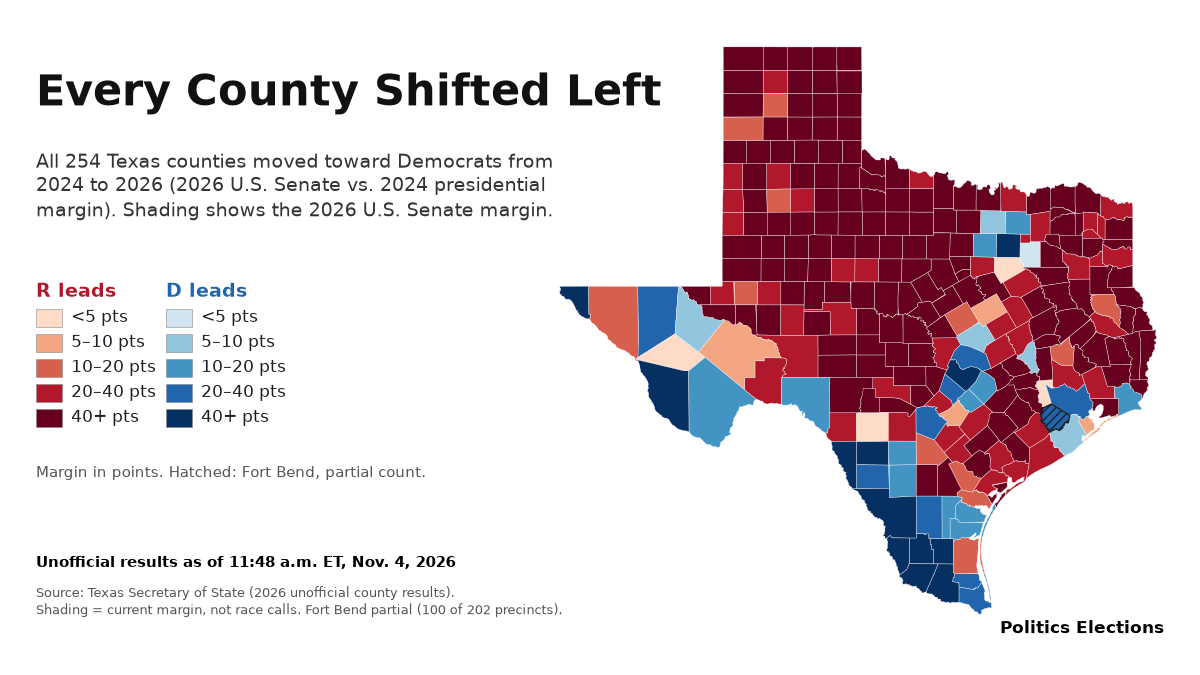
The map compares each county’s margin in the 2026 Senate race with its margin in the 2024 presidential race. Each arrow points in the direction the county moved, and its length shows how far. Every arrow points the same way. All 254 counties moved toward Democrats, and none moved toward Republicans, according to Texas Secretary of State results.
The median county moved 17.7 points. The smallest shift was 6.6 points, in King County, where the Republican margin went from R+91.1 to R+84.5. The largest was 71.8 points, in Starr County. Twenty-eight counties that Donald Trump carried in 2024 voted for Talarico.
The border snapped back
The border counties that swung hardest to Trump in 2024 swung back the hardest. Starr County went from Trump by 16.0 points to Talarico by 55.8. Zapata moved 63.1 points and Maverick 59.5. Webb, Hidalgo and Cameron, each with more than 50,000 Senate votes, moved 49.5, 49.3 and 44.3 points. All of those counties are now well to the left of their 2020 presidential margins.
Suburbs and big cities
Suburban counties moved too. Collin County went from R+11.1 for Trump to D+12.1 for Talarico. Denton went from R+13.1 to D+8.4, and Williamson from R+2.5 to D+20.3. All three voted for Trump in 2024 and for Talarico in 2026. Fort Bend moved 27.6 points, though only 100 of its 202 precincts had reported.
Among the five biggest counties, Tarrant flipped, going from Trump by 5.1 points to Talarico by 19.2. Harris moved 27.4 points toward Democrats, Bexar 25.7, Dallas 23.3 and Travis 19.2.
The smallest shifts came in small, deep-red rural counties in the Panhandle, West Texas and East Texas, such as King, Roberts, Stonewall, Motley and Borden. Those counties still voted heavily Republican, but by less than in 2024. Among counties with at least 50,000 Senate votes, Parker moved least, 15.5 points, with Comal close behind at 16.3.
The statewide trend from 2020 to 2026
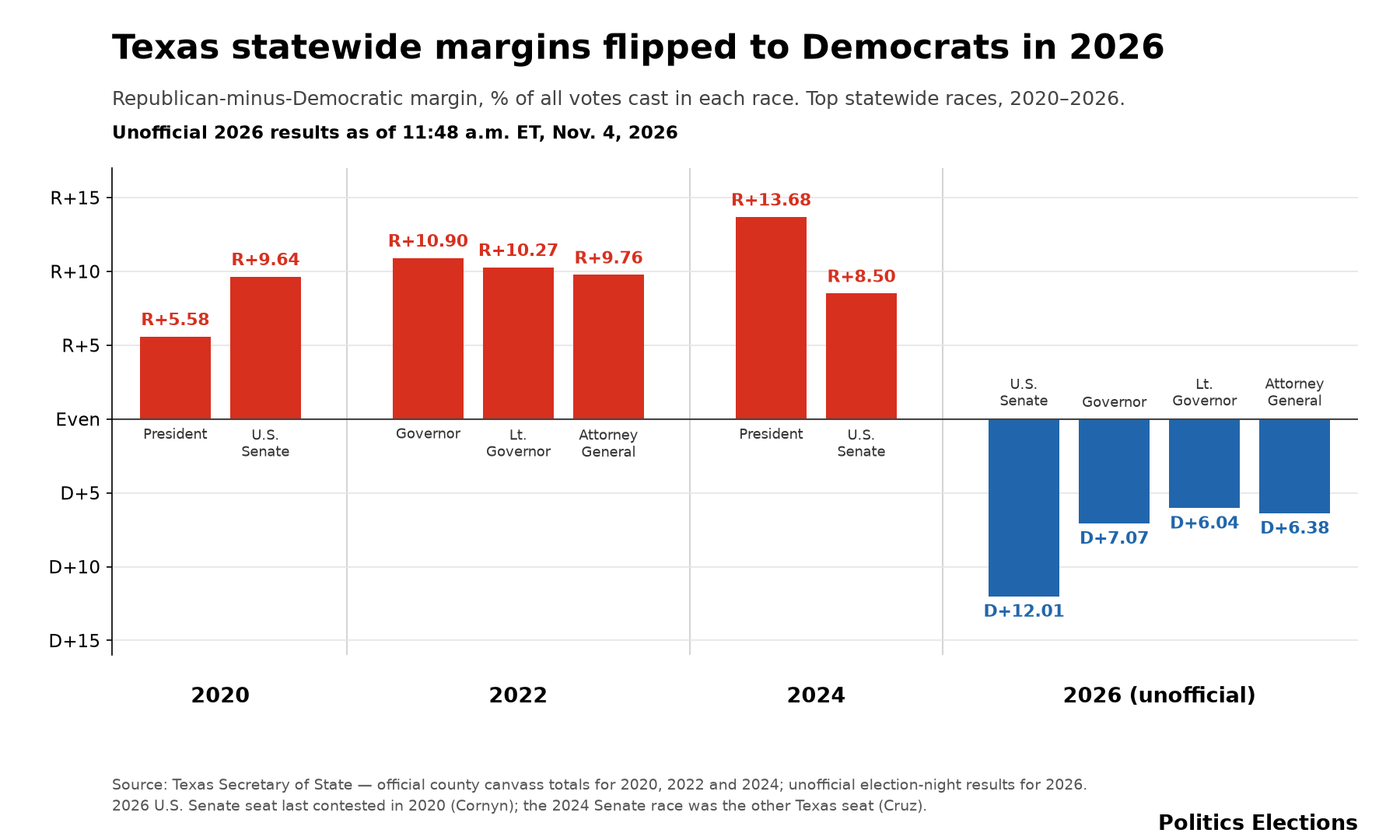
For three straight cycles, Republicans won the top of the Texas ballot comfortably. According to the Texas Secretary of State’s official canvass, Trump carried Texas by 5.6 points in 2020, and Republican John Cornyn won this same Senate seat by 9.6 points. In 2022, Greg Abbott won the governor’s race by 10.9 points, Dan Patrick won lieutenant governor by 10.3 and Paxton won attorney general by 9.8. In 2024, Trump carried Texas by 13.7 points and Ted Cruz won the other Senate seat by 8.5.
In 2026, the unofficial results flip every one of those top races. Talarico leads by 12.0 points. That is a 21.7-point swing from the last race for this seat in 2020, a 20.5-point swing from the 2024 Senate race and a 25.7-point swing from the 2024 presidential race. The governor’s race shows D+7.07, lieutenant governor D+6.04 and attorney general D+6.38.
The count is not finished. Fort Bend County had reported 100 of its 202 precincts, and the AP estimated that about 98% of the expected Senate vote had been counted as of 11:52 a.m. ET, according to NPR’s results page. So far, 9,832,765 votes have been counted in the Senate race, according to the Texas Secretary of State. That compares with 8,102,908 in the 2022 governor’s race and 11,388,674 in the 2024 presidential race.
What happened to the Texas statewide candidates
Democrats lead every statewide race in unofficial Secretary of State results, but only some of those races have been called.
- Governor: The Associated Press called the race for Democrat Gina Hinojosa over Republican Gov. Greg Abbott at 11:17 p.m. ET Tuesday, and NBC News also projects her the winner, 52.8% to 45.7%. NBC lists the race as a flip. Abbott conceded, CBS News reported.
- Lieutenant governor: The AP called the race for Democrat Vikki Goodwin over Republican Lt. Gov. Dan Patrick at 3:00 a.m. ET Wednesday, and NBC News also projects her the winner, 51.7% to 45.7%. Patrick conceded, CBS News reported.
- Attorney general: The AP called the race for Democrat Nathan Johnson over Republican Mayes Middleton at 2:57 a.m. ET Wednesday, and NBC News also projects him the winner, 52.3% to 46.0%.
- Railroad commissioner: The AP called the race for Democrat Jon Rosenthal over Republican Bo French at 3:36 a.m. ET Wednesday, and NBC News also projects him the winner, 52.5% to 45.6%.
The races for comptroller, land commissioner and agriculture commissioner, and every Texas Supreme Court and Court of Criminal Appeals race, had not been called by the Associated Press as of 11:52 a.m. ET, according to NPR’s results page, or projected by NBC News as of 9:54 a.m. ET. Democrats lead all of them. Democrat Clayton Tucker declared victory in the agriculture commissioner race, the Texas Standard reported, but a declaration is not a race call.
| Office | Republican | Democrat | 2026 margin (last time) | Call status |
|---|---|---|---|---|
| U.S. Senator | Ken Paxton 43.0% | James Talarico 55.0% | D+12.01 (2020: R+9.64) | AP called: Talarico. NBC News projects Talarico. Flip. |
| Governor | Greg Abbott (I) 45.7% | Gina Hinojosa 52.8% | D+7.07 (2022: R+10.90) | AP called: Hinojosa. NBC News projects Hinojosa. Flip. |
| Lieutenant Governor | Dan Patrick (I) 45.7% | Vikki Goodwin 51.7% | D+6.04 (2022: R+10.27) | AP called: Goodwin. NBC News projects Goodwin. |
| Attorney General | Mayes Middleton 46.0% | Nathan Johnson 52.3% | D+6.38 (2022: R+9.76) | AP called: Johnson. NBC News projects Johnson. |
| Comptroller | Don Huffines 46.2% | Sarah Eckhardt 51.3% | D+5.09 (2022: R+15.44) | Not yet called |
| Land Commissioner | Dawn Buckingham (I) 47.0% | Benjamin Flores 51.4% | D+4.43 (2022: R+14.00) | Not yet called |
| Agriculture Commissioner | Nate Sheets 46.7% | Clayton Tucker 51.3% | D+4.60 (2022: R+12.66) | Not yet called |
| Railroad Commissioner | Bo French 45.6% | Jon Rosenthal 52.5% | D+6.91 (2024: R+16.64) | AP called: Rosenthal. NBC News projects Rosenthal. |
| Chief Justice, Supreme Court | Jimmy Blacklock (I) 47.6% | Maggie Ellis 52.4% | D+4.84 (2020: R+8.49) | Not yet called |
| Supreme Court, Place 2 (unexpired term) | James P. Sullivan (I) 47.8% | Chari Kelly 52.2% | D+4.45 (2024: R+16.46) | Not yet called |
| Supreme Court, Place 7 | Kyle Hawkins (I) 47.2% | Kristen Hawkins 52.8% | D+5.51 (2020: R+8.96) | Not yet called |
| Supreme Court, Place 8 | Brett Busby (I) 48.0% | Gisela D. Triana 52.0% | D+3.97 (2020: R+9.32) | Not yet called |
| Court of Criminal Appeals, Place 3 | Thomas Smith 47.6% | Okey Anyiam 50.0% | D+2.40 (2020: R+9.06) | Not yet called |
| Court of Criminal Appeals, Place 4 | Kevin Patrick Yeary (I) 48.3% | Audra Riley 51.7% | D+3.44 (2020: R+9.63) | Not yet called |
| Court of Criminal Appeals, Place 9 | John Messinger 47.7% | Holly Taylor 52.3% | D+4.51 (2020: R+10.60) | Not yet called |
Swipe to see more →
The U.S. House in Texas
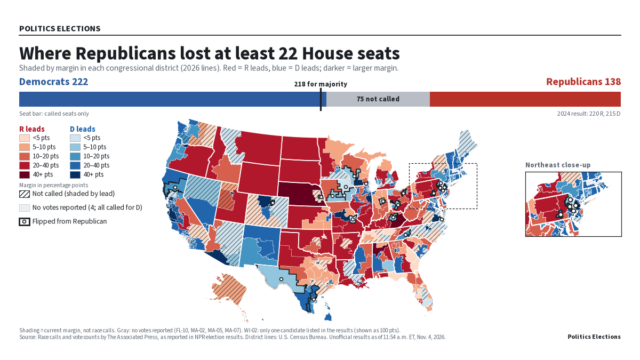
NBC News’ count for Texas’ 38 U.S. House seats, updated at 9:51 a.m. ET, showed 18 seats called for Republicans, 13 called for Democrats and seven not yet called. The seven uncalled seats are the 2nd, 5th, 9th, 22nd, 27th, 32nd and 38th districts. Republicans lead in six of them and the Democrat leads in the 9th, but those are current leads, not race calls. NBC News has called the 3rd, 6th, 8th and 12th districts for Republicans. The AP had not called any of the seven as of 11:52 a.m. ET, according to NPR’s results page.
Two Republican-held seats flipped, according to Associated Press calls shown on NPR’s Texas results page. In the 15th District, Democrat Bobby Pulido defeated Republican Rep. Monica De La Cruz. In the open 23rd District, Democrat Katy Padilla Stout defeated Republican Brandon Herrera. Democrats also held three South Texas seats: Rep. Henry Cuellar won the 28th District, Rep. Vicente Gonzalez won the 34th and Johnny C. Garcia won the redrawn 35th.
The mid-decade redistricting was meant to flip up to five Democratic seats, NBC News reported. Of those targets, Democrats lead in the 9th, 28th, 34th and 35th districts, and Republicans lead in the 32nd. Two of those, the 9th and 32nd, have not been called. In the 9th, Democrat Leticia Gutierrez leads Republican Alex Mealer 98,079 to 72,340. In the 32nd, Republican Jace Yarbrough leads Democrat Dan Barrios 142,834 to 134,781.
By current leads in Texas Secretary of State results, Republicans are ahead in 24 seats and Democrats in 14. The Texas Tribune also projects a final delegation of 24 Republicans and 14 Democrats. At the start of the current Congress, the delegation was 25 Republicans and 13 Democrats. With seven seats still uncalled, that count is not final.
| District | Republican | Democrat | Current leader (not a call) | Call status |
|---|---|---|---|---|
| TX-2 (open) | Steve Toth 144,748 | Shaun Finnie 139,167 | R+2.0 | Not yet called |
| TX-27 | Michael Cloud (I) 144,467 | Tanya Lloyd 137,927 | R+2.3 | Not yet called |
| TX-5 | Lance Gooden (I) 130,278 | Chelsey Hockett 122,855 | R+2.9 | Not yet called |
| TX-32 (open) | Jace Yarbrough 142,834 | Dan Barrios 134,781 | R+2.9 | Not yet called |
| TX-22 | Trever Nehls 134,197 | Marquette Greene-Scott 124,995 | R+3.6 | Not yet called |
| TX-38 | Jon Bonck 157,261 | Melissa McDonough 144,397 | R+4.2 | Not yet called |
| TX-9 | Alex Mealer 72,340 | Leticia Gutierrez 98,079 | D+15.1 | Not yet called |
Swipe to see more →
Nationally, NBC News projects Democrats win control of the House. At its last check, NBC had called 231 seats for Democrats and 144 for Republicans, a net Democratic gain of 29, and estimates Democrats will finish with at least 258 seats. The AP reports that Democrats won control of both chambers of Congress.
The U.S. Senate: Did Republicans hold Texas?
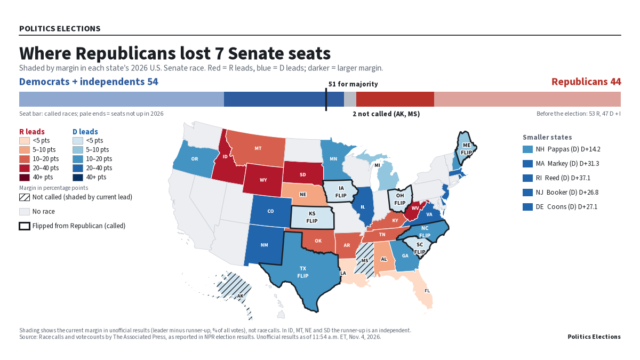
No. Talarico received 5,410,057 votes (55.0%) to Paxton’s 4,228,924 (43.0%), according to unofficial Texas Secretary of State results. Libertarian candidate Brown received 188,815. The Associated Press called the race for Talarico, and NBC News projects him the winner. The AP described Talarico as the first Texas Democrat to win statewide in more than 30 years.
The Texas seat was one of seven Democratic Senate pickups listed in AP data at 11:55 a.m. ET, along with Kansas, Iowa, Ohio, Maine, North Carolina and South Carolina. NBC News projects Democrats win control of the Senate. Its count at 9:19 a.m. ET stood at 54 Democrats and 44 Republicans, with seven seats flipped to Democrats. Final seat totals in both chambers have not been projected, because several races are still uncalled. For how this race looked before Election Day, see our Texas Senate race polling coverage.
The Texas Legislature: House and Senate results
Control of the Texas House has not been called by the Associated Press or the Texas Tribune. As of 6 a.m. Wednesday, the AP had called six Democratic flips there, the Tribune reported in a story last updated at 8:24 a.m. ET. Democrats needed to flip 14 Republican-held seats for a majority of the 150-member chamber, the Tribune reported. The Texan, a Texas political news site, has reported that Democrats took the House, citing Secretary of State results. That is the outlet’s report, not an AP call. No NBC News call on the chamber was found.
In unofficial Texas Secretary of State results as of 11:48 a.m. ET, Democrats lead in 84 House districts and Republicans in 66. Democrats lead in 22 districts Republicans held, and Republicans lead in none that Democrats held. Those are leads, not calls. Eight of the Democratic leads in Republican-held districts are under 2 points, and Republicans lead the 61st and 67th districts by less than half a point. In one of the Democratic leads, the 93rd District in Tarrant County, Democrat Ericka Lomick suspended her campaign in September, the Tribune reported.
The state Senate is a different story. The Texas Tribune reported that “the line in the Texas Senate was holding firm at 19 Republicans and 12 Democrats,” including Democratic Sen. Taylor Rehmet winning Senate District 9. No AP or NBC News call on chamber control was found, so that result is reported, not called. Sixteen of the 31 Senate seats were on the ballot. In unofficial Secretary of State results, Republicans lead in 11 of them and Democrats in five, and every seat is led by the party that held it before the election, including District 9, which Rehmet flipped to Democrats in a January 2026 special election runoff. The closest are District 9 (D+2.5), District 2 (R+2.7), District 11 (R+3.0) and District 5 (R+6.6).
Analysis: Can the Texas Senate check a Democratic governor?
Analysis. This section is Politics Elections analysis, not news reporting. It relies on the results and race calls cited above, the Texas Constitution and the Texas Senate rules.
A blue Texas at the top of the ballot does not mean a blue Texas Capitol. Under Article IV, Section 14 of the Texas Constitution, every bill must pass both the House and the Senate before it reaches the governor. On the Texas Tribune’s count, Republicans keep a 19-12 Senate majority. Other outlets’ counts differ by a seat, and no count has been called by the AP or NBC News. That makes the Senate the chamber that decides how much of a Democratic agenda becomes law, and whether it can serve as a firewall.
What a Democratic governor and lieutenant governor can do
- The veto. Gina Hinojosa, whom the AP called the winner of the governor’s race, could veto any bill the Legislature sends her. On spending bills she could also strike individual items of appropriation and sign the rest, a line-item veto, under Article IV, Section 14. A veto issued after the Legislature adjourns is filed with the secretary of state within 20 days instead of being returned to lawmakers.
- Special sessions. Between regular sessions, the Legislature meets only when the governor convenes it, under Article III, Section 5 and Article IV, Section 8. The governor’s proclamation sets the agenda: a special session lasts no more than 30 days, and lawmakers may pass laws only on subjects the governor designates in the proclamation or presents to them, under Article III, Section 40.
- Appointments. The governor appoints members of state boards and commissions and fills judicial vacancies, the Texas Tribune reported. Under Article IV, Section 12, those appointments need the consent of two-thirds of the senators present, a requirement repeated in Senate Rule 16.06.
- The Senate’s presiding officer. Vikki Goodwin, whom the AP called the winner of the lieutenant governor’s race, would be president of the Senate under Article IV, Section 16, with the deciding vote when the Senate is equally divided. Much of the office’s authority comes from the Senate rules adopted each regular session, the Tribune has reported. Under the current rules, the president refers every bill to committee (Rule 7.06), appoints committees unless the Senate directs otherwise (Rule 11.01) and decides questions of order, subject to appeal (Rule 1.01). Republicans are expected to keep their Senate majority, and some have discussed curbing the lieutenant governor’s authority, the Tribune reported.
The Texas Senate firewall, by the numbers
Here is how the Tribune’s reported 19-12 line measures against each vote threshold in the 31-member Senate, assuming every senator is present. The thresholds come from the Texas Constitution and the Senate’s vote requirements.
| Senate vote | Votes needed (31 present) | 19 Republicans | 12 Democrats | Source |
|---|---|---|---|---|
| Quorum to do business | 21 (two-thirds of members) | Cannot make a quorum alone | Can deny a quorum by staying away | Tex. Const. Art. III, Sec. 10; Rule 5.02 |
| Take up a bill out of order | 18 (five-ninths present) | Enough alone | Cannot block; need six Republicans to bring up their own bills | Rule 5.13 |
| Pass a bill on second reading | 16 (majority present) | Enough alone | Cannot block | Rule 16.09 |
| Change the Senate rules | 16 (majority of members) | Enough alone | Cannot block | Rule 22.01 |
| Confirm a governor’s appointee | 21 (two-thirds present) | Can block; 11 votes are enough | Need nine Republicans to confirm | Tex. Const. Art. IV, Sec. 12; Rule 16.06 |
| Override a veto | 21 (two-thirds) | Two votes short | Can sustain a veto with 11 votes | Tex. Const. Art. IV, Sec. 14; Rule 6.20 |
| Propose a constitutional amendment | 21 (two-thirds of members) | Two votes short | Can block | Art. XVII §1; Rule 10.02 |
Swipe to see more →
So the firewall holds in some places and not in others. On the reported count, Republican senators could set the Senate’s agenda, pass or stop bills, rewrite the rules that give the lieutenant governor her power and withhold confirmation from a governor’s nominees, all without a Democratic vote. They could not override a veto or send a constitutional amendment to voters without Democratic votes: two on the Tribune’s 19-12 count, one if Republicans hold 20 seats. And because a quorum takes 21 senators, Democrats could keep the Senate from doing business by staying away, though the Constitution lets a smaller number compel absent members to attend.
The Senate’s agenda rule has already changed twice since 2015. In 2015, the Senate lowered the vote needed to bring up a bill from two-thirds to three-fifths, and in 2021 it lowered it again to five-ninths, 18 votes, on an 18-13 vote, the Texas Tribune reported. Because the rules are adopted each regular session, the same majority could change them again when the Legislature convenes in January.
The House is the other half of the equation. Democrats lead in 84 House districts, but those are leads, not calls, and chamber control has not been called. Overriding a veto takes two-thirds of the members present in the House as well, 100 votes if all 150 members are present. Republicans lead in 66 districts. Two seats could also open up in the Senate: Democratic Sens. Nathan Johnson and Sarah Eckhardt were on the statewide ballot. The AP called the attorney general’s race for Johnson, and Eckhardt leads the uncalled comptroller’s race. A vacant Senate seat is filled by special election, and the governor issues the writ for it under Article III, Section 13.
In Washington
The federal firewall did not hold. NBC News projects Democrats win control of the U.S. Senate, with 54 Democratic seats at its 9:19 a.m. ET count, and AP data at 11:55 a.m. ET list seven Democratic pickups, including Texas. (See our U.S. Senate 2026 postmortem for all seven.) That is short of the 60 votes, three-fifths of the Senate, needed to end a filibuster on legislation, according to the Senate Historical Office. President Trump can still veto bills, and overriding him takes two-thirds of both chambers under Article I, Section 7 of the U.S. Constitution.
Sources: Texas Secretary of State (unofficial 2026 election-night results as of 11:48 a.m. ET, Nov. 4, 2026; official county canvass for 2020, 2022 and 2024), via the Secretary of State’s elections page. Race calls: The Associated Press (as shown on NPR’s results pages) and NBC News. Texas Senate composition, Texas House flips and the powers of the governor and lieutenant governor as reported by the Texas Tribune; Texas House control as reported by The Texan. Vote thresholds and executive powers: the Texas Constitution, Article III and Article IV, and the Senate Rules of the 89th Legislature. Federal thresholds: the Senate Historical Office and Article I, Section 7 of the U.S. Constitution. Concessions as reported by CBS News. Margins are Republican minus Democratic votes as a share of all votes cast in each race, including minor-party and write-in votes. Fort Bend County results were partial (100 of 202 precincts) at the time of this update. Graphics: Politics Elections.