Vote totals are from U.S. Senate Roll Call Vote No. 270. Provisions are from the Senate engrossed amendment to H.R. 2347. Checked at 6:55 AM ET, Nov. 23, 2026.
The Senate passed a permitting reform bill Thursday night, 62-33, and sent the measure to the House. The bill is H.R. 2347, as amended, officially titled the Bipartisan American Affordability and Jobs Act of 2026, or BAAJA.
The roll call was Vote No. 270. Voting began at 9:30 p.m. ET, and the bill passed at 10:02 p.m., the Senate Daily Press Gallery recorded. Forty-seven Republicans voted yes, as did 14 Democrats and independent Sen. Angus King of Maine. Sens. Josh Hawley of Missouri and Mike Rounds of South Dakota were the two Republicans who voted no. Five senators did not vote: Bill Cassidy of Louisiana, John Cornyn of Texas, Mitch McConnell of Kentucky, Chris Murphy of Connecticut and Tommy Tuberville of Alabama.
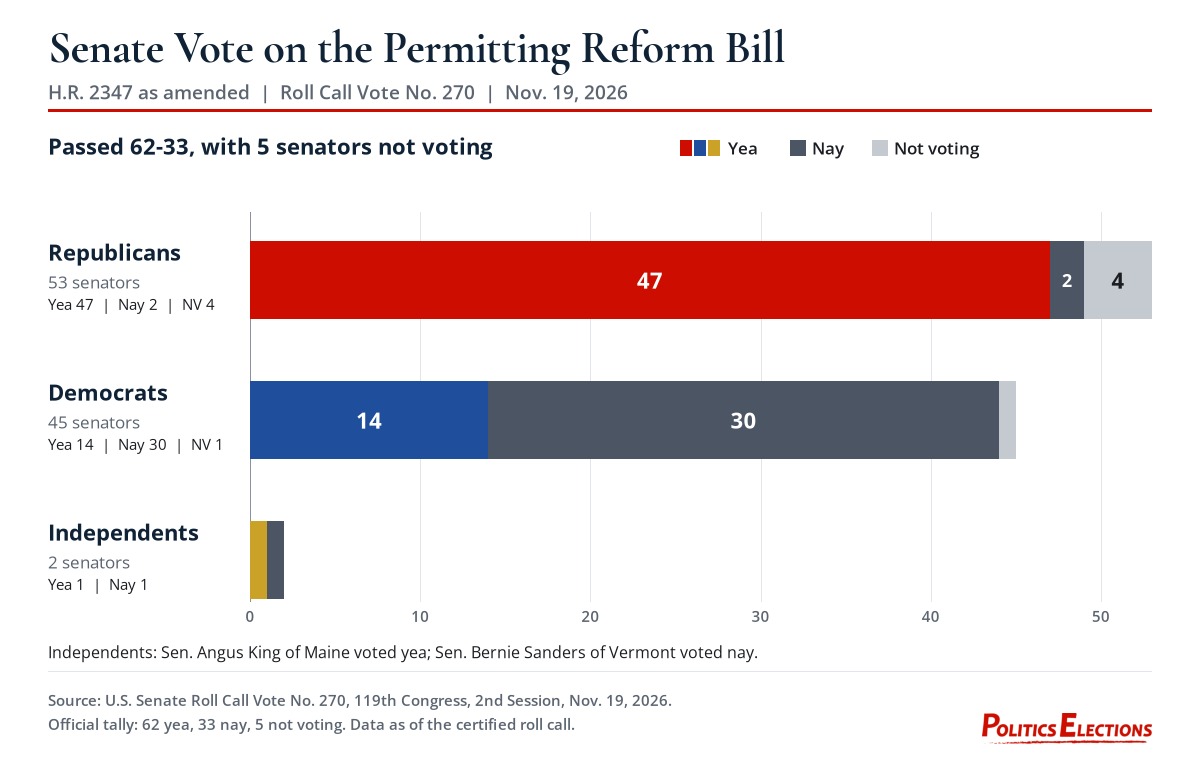
The 15 Democrats and independents who voted yes were Sens. Chris Coons of Delaware, John Fetterman of Pennsylvania, Ruben Gallego of Arizona, Martin Heinrich of New Mexico, John Hickenlooper of Colorado, Angus King of Maine, Amy Klobuchar of Minnesota, Gary Peters of Michigan, Jack Reed of Rhode Island, Jacky Rosen of Nevada, Brian Schatz of Hawaii, Chuck Schumer of New York, Elissa Slotkin of Michigan, Mark Warner of Virginia and Sheldon Whitehouse of Rhode Island.
The lead authors were Sen. Shelley Moore Capito of West Virginia, chair of the Environment and Public Works Committee; Sen. Mike Lee of Utah, chair of the Energy and Natural Resources Committee; Heinrich, the Energy Committee’s ranking member; and Whitehouse, the EPW ranking member.
“Tonight, the passage of permitting reform in the Senate finally became reality and we took a major step towards addressing the affordability concerns of the American people,” Capito said in a committee statement after the vote. She thanked Whitehouse, Lee and Heinrich and cited “the support from the Trump administration and over one thousand stakeholders,” and she urged the House to pass the bill “expeditiously.”
Lee, in a statement from the Energy Committee, called it “a big day for the American people.” He said the bill is “all about giving the American people the freedom to build, the freedom to build things that the American people need.”
The vote is the largest measure so far in this lame-duck session of Congress. The current Senate still has other business pending, but this bill now sits with the House.
What the permitting reform bill changes
The Senate did not pass the House’s original version of H.R. 2347. The House had first passed the bill as a tax measure on the treatment of certain damages. The Senate struck that text and inserted the permitting package, while retaining a related tax title as Division C. Because the two chambers have not passed the same text, the House has to vote again if the bill is to become law.
| Topic | What the Senate-passed text does |
|---|---|
| Environmental reviews | A 1-year deadline for an environmental assessment and a 2-year deadline for an impact statement, plus 7-, 45-, 90- and 120-day follow-on clocks for findings, records of decision and remaining federal permits (sec. 1106) |
| Lawsuits | A 150-day filing window, an appeals-court venue, and remand without vacatur as the ordinary NEPA remedy, with up to 180 days for the agency to fix the problem (sec. 1110) |
| Existing permits | Agencies generally may not revoke or materially alter permits in effect on or after Nov. 6, 2026, for covered projects that already have their federal authorizations, subject to listed exceptions (sec. 1401) |
| Transmission | Revises FERC permitting for certain interstate lines of at least 230 kilovolts and includes rules for upgrades in existing rights-of-way (sec. 2101) |
| Data centers | FERC has 90 days to revise transmission pricing so computational load sites pay embedded and incremental costs; retail incremental costs may not be shifted to other customers (sec. 2107) |
From the Senate engrossed amendment to H.R. 2347, Government Publishing Office.
Environmental reviews. The one-year and two-year review clocks in section 1106 run from the earlier of the agency’s decision that the review is required or its notice that the application is complete. The follow-on 7-, 45-, 90- and 120-day deadlines then govern findings of no significant impact, records of decision and remaining federal permits. If an agency misses a deadline, the bill directs senior officials to focus on the delay, and a project sponsor may petition a court.
Lawsuits. Under section 1110, NEPA-based challenges generally must be filed within 150 days and heard in the federal court of appeals for the circuit where the project will be built, or in the D.C. Circuit for agency rules and projects with no physical location.
If a court finds a NEPA violation, the ordinary remedy is a remand without vacating the approval or issuing an injunction, with up to 180 days for the agency to fix the problem. The approval stays in effect, and work may continue, during that remand. A preliminary injunction remains available for a likely violation of certain other federal laws, if the usual tests are met.
Permit revocation. Section 1401’s limit applies to projects with a non-federal sponsor that already have their necessary federal permits. The exceptions include a court order, a material breach or violation, fraud, certain urgent harms based on new information, a request from the permit holder, and an action taken under applicable law or regulation.
Transmission. The section 2101 revisions apply to certain interstate electric transmission facilities of at least 230 kilovolts that the Federal Energy Regulatory Commission finds necessary in the national interest, under section 216 of the Federal Power Act. Separate provisions cover upgrades in existing rights-of-way and transmission planning.
Data centers. A “computational load site” in section 2107 includes facilities used for data centers, artificial intelligence work or cryptocurrency mining. FERC would have 90 days after enactment to revise its 1994 transmission pricing policy so those sites pay the embedded cost and a reasonable assessment of the incremental cost of the service built to serve them, rather than shifting those costs to other customers, including residential ratepayers.
The bill also amends Clean Water Act and Endangered Species Act procedures, nuclear licensing, geothermal and other energy permitting, and historic-preservation rules.
What the House does next
The House has not scheduled a vote on the Senate-passed text. It is in recess for Thanksgiving.
Majority Leader Steve Scalise of Louisiana, asked whether the House would take up the Senate version, told NBC News: “Well, we want to see a bill pass both chambers.” He added, “Obviously, the details matter.” And, in a separate excerpt: “Hopefully, they pass a good bill back, and if not, we’ll work out those differences. But we want to get a bill to the president’s desk, and that’s still got a great chance to happen.”
Senate Majority Leader John Thune of South Dakota told reporters, in remarks reported by NBC News, that the cleaner path is for the House to pass the Senate bill as it stands. “It has been litigated now for months. Continues to be,” Thune said. “Everything gets more complicated over here procedurally, and if it were to go over there and then come back over here, I can’t predict what happens. So hopefully there’ll be the critical mass there to move it.”
He also said the bill has “been through the full monty when it comes to the legislating process.”
If the House passes the Senate text unchanged, the bill goes to President Donald Trump. If the House changes it, the measure returns to the Senate. No date has been set.