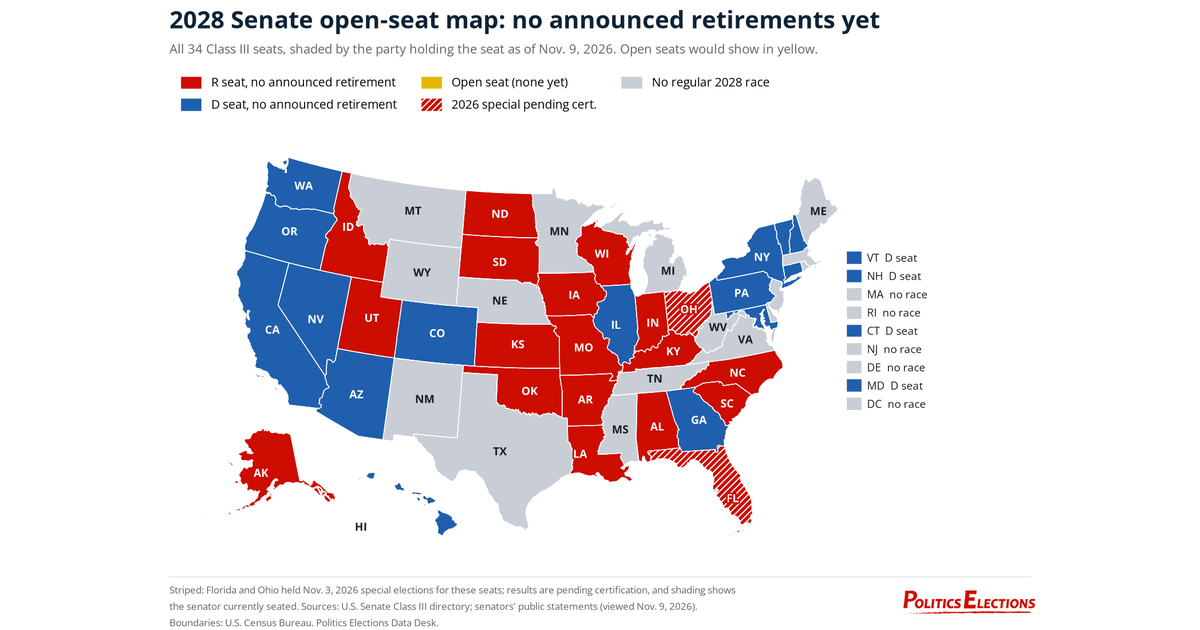
The numbers: As of November 9, 2026, there are no 2028 Senate open seats. None of the 34 senators in the class up in 2028 has officially announced a retirement, and none of those seats is vacant. Republicans hold 19 of the seats and Democrats hold 15, according to the U.S. Senate’s Class III directory.
Data as of November 9, 2026; this page lists only officially announced retirements and vacancies, each with a dated source. Sources listed below.
Which 2028 Senate Seats Are Open?
An open seat is one where the sitting senator will not be on the general-election ballot, usually because of a retirement, resignation, death or a run for another office. On this map, a seat counts as open only after the senator announces a retirement on the record or the seat becomes vacant. Speculation, unnamed sources and “undecided” statements do not count.
By that standard, the 2028 open-seat count is zero. For the full list of seats and holders, see the 2028 Senate map of all 34 Class III seats. This page tracks which of those seats open up.
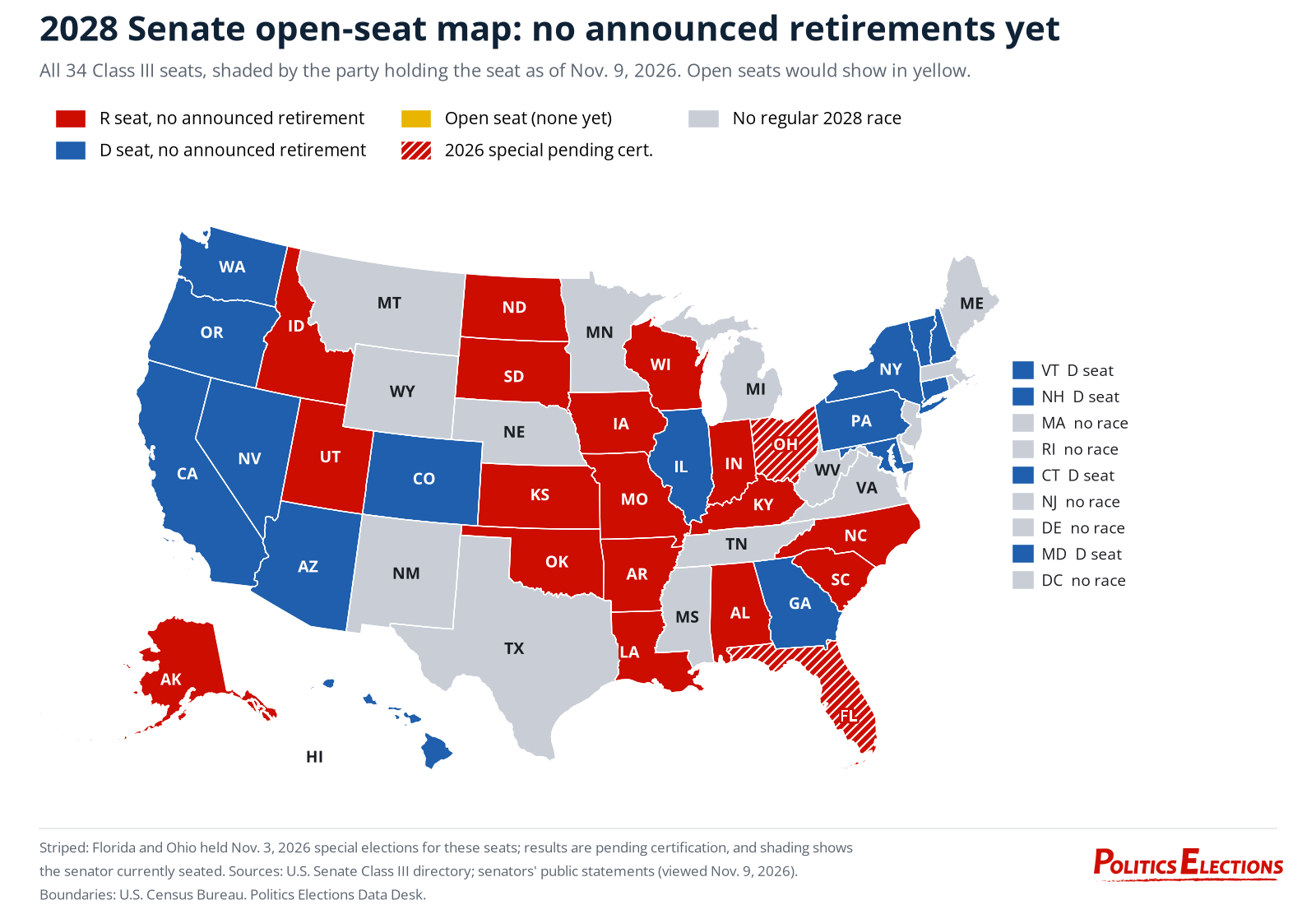
Open-Seat Status by State: Full Table
| State | Class III senator | Announced retirement | If the seat opens early | Official source |
|---|---|---|---|---|
| Alabama | Katie Britt (R) | None | Governor appoints; special election | U.S. Senate |
| Alaska | Lisa Murkowski (R) | None | Governor appoints; special election | U.S. Senate |
| Arizona | Mark Kelly (D) | None | Governor appoints; election at next general | U.S. Senate |
| Arkansas | John Boozman (R) | None | Governor appoints; election at next general | U.S. Senate |
| California | Alex Padilla (D) | None | Governor appoints; election at next general | U.S. Senate |
| Colorado | Michael Bennet (D) | None | Governor appoints; election at next general | U.S. Senate |
| Connecticut | Richard Blumenthal (D) | None | Limited appointment; special election | U.S. Senate |
| Florida | Ashley Moody (R) | None; special result pending certification | Governor appoints; election at next general | U.S. Senate |
| Georgia | Raphael Warnock (D) | None | Governor appoints; election at next general | U.S. Senate |
| Hawaii | Brian Schatz (D) | None | Governor appoints; election at next general | U.S. Senate |
| Idaho | Mike Crapo (R) | None | Governor appoints; election at next general | U.S. Senate |
| Illinois | Tammy Duckworth (D) | None | Governor appoints; election at next general | U.S. Senate |
| Indiana | Todd Young (R) | None | Governor appoints; election at next general | U.S. Senate |
| Iowa | Chuck Grassley (R) | None | Governor appoints; election at next general | U.S. Senate |
| Kansas | Jerry Moran (R) | None | Governor appoints; election at next general | U.S. Senate |
| Kentucky | Rand Paul (R) | None | No appointment; special election | U.S. Senate |
| Louisiana | John Kennedy (R) | None | Limited appointment; special election | U.S. Senate |
| Maryland | Chris Van Hollen (D) | None | Governor appoints; election at next general | U.S. Senate |
| Missouri | Eric Schmitt (R) | None | Governor appoints; election at next general | U.S. Senate |
| Nevada | Catherine Cortez Masto (D) | None | Governor appoints; election at next general | U.S. Senate |
| New Hampshire | Maggie Hassan (D) | None | Governor appoints; election at next general | U.S. Senate |
| New York | Chuck Schumer (D) | None | Governor appoints; election at next general | U.S. Senate |
| North Carolina | Ted Budd (R) | None | Governor appoints; election at next general | U.S. Senate |
| North Dakota | John Hoeven (R) | None | No appointment; special election | U.S. Senate |
| Ohio | Jon Husted (R) | None; special result pending certification | Governor appoints; election at next general | U.S. Senate |
| Oklahoma | James Lankford (R) | None | Governor appoints; special election | U.S. Senate |
| Oregon | Ron Wyden (D) | None | Governor appoints; special election | U.S. Senate |
| Pennsylvania | John Fetterman (D) | None | Governor appoints; election at next general | U.S. Senate |
| South Carolina | Tim Scott (R) | None | Governor appoints; election at next general | U.S. Senate |
| South Dakota | John Thune (R) | None | Governor appoints; election at next general | U.S. Senate |
| Utah | Mike Lee (R) | None | Governor appoints; election at next general | U.S. Senate |
| Vermont | Peter Welch (D) | None | Governor appoints; special election | U.S. Senate |
| Washington | Patty Murray (D) | None | Governor appoints; special election | U.S. Senate |
| Wisconsin | Ron Johnson (R) | None | No appointment; special election | U.S. Senate |
Swipe to see more →
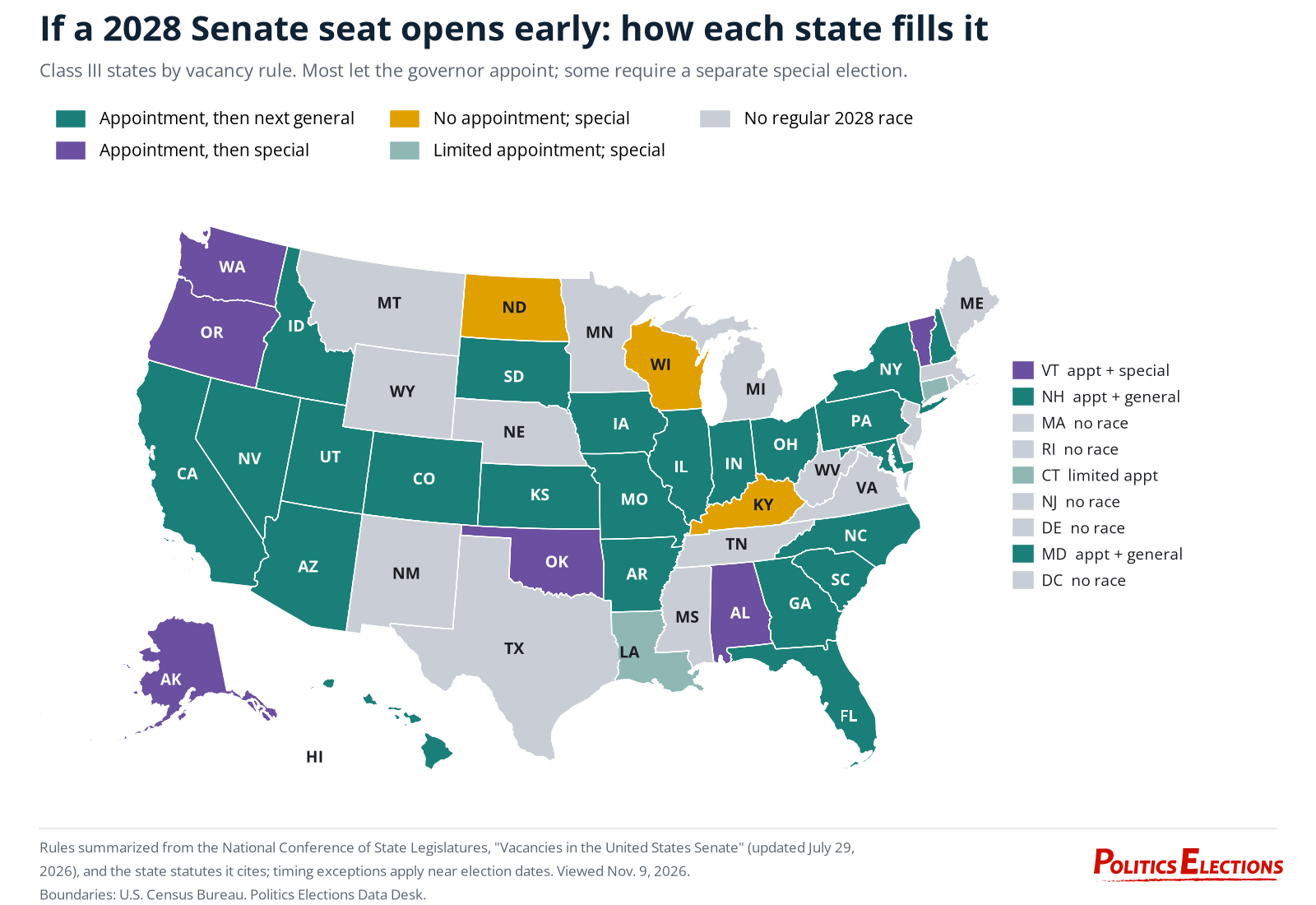
The last column summarizes each state’s rule for filling a Senate vacancy, as compiled by the National Conference of State Legislatures (updated July 29, 2026). Timing exceptions apply when a vacancy occurs close to an election.
Florida and Ohio: Specials Pending Certification
Two Class III seats changed hands by appointment in 2025. Florida’s Ashley Moody and Ohio’s Jon Husted were appointed after vacancies, and the Senate lists both as current senators. Both seats were on the November 3, 2026 ballot in special elections for the rest of the term ending January 3, 2029. As of November 9, 2026, those results are pending certification.
Neither seat is counted as open. Whoever is certified as the winner of each special will hold the seat going into the regular 2028 election. The winner of each special can be sworn in once the state certifies the result.
What Senators Have Said So Far
Most Class III senators have not made a formal 2028 announcement either way. South Carolina’s Tim Scott said in March 2026 that he will seek re-election in 2028, the Post and Courier reported. Iowa’s Chuck Grassley said on October 13, 2026 that he would not decide on a 2028 campaign until next year, Iowa’s News Now reported.
An undecided senator is not an open seat. This map will mark a seat open only when the senator announces a retirement on the record or the seat becomes vacant, and it will date each change.
If a Seat Opens Early: How States Fill It
A resignation or death before 2028 would create a vacancy rather than a normal open seat, and state law decides what happens next. In 23 of the 34 Class III states, the governor appoints a replacement who serves until an election at the next regular general election. Six more let the governor appoint but require a separate special election: Alabama, Alaska, Oklahoma, Oregon, Vermont and Washington.
Kentucky, North Dakota and Wisconsin do not allow an interim appointment, so the seat stays vacant until a special election. Connecticut and Louisiana allow only limited or temporary appointments, according to NCSL. Among Class III states, Arizona, Colorado, Hawaii, Kansas, Maryland, Nevada, North Carolina and Utah require an appointee to be from the same party as the departing senator.
Vacancies outside Class III can also put extra Senate races on the 2028 ballot. If a senator from Class I or Class II leaves early, that state’s law may require a special election that falls on the same November 7, 2028 date.
How to Track Open Seats Through 2028
Retirement announcements usually come from the senator’s own office or campaign. Candidate filing deadlines are the final test: once a state’s filing period closes, the ballot shows whether the incumbent is running. Many 2028 filing deadlines fall in the first half of the year, and the presidential nominating season runs alongside them; see the 2028 presidential primary calendar.
Several Class III states are also presidential battlegrounds, including Arizona, Georgia, Nevada, North Carolina, Pennsylvania and Wisconsin; see the 2028 swing-state map. The same ballot carries the race for the White House and 11 governorships; see the 2028 Electoral College map and the 2028 governor map.
What an Open Seat Does and Doesn’t Tell You
Open seats draw more candidates and more spending because no incumbent is on the ballot. But an open seat is not automatically competitive. A retirement in a state that leans heavily to one party may change the nominee without changing the party that holds the seat.
Senate Open-Seat Questions
How many 2028 Senate seats are open? None as of November 9, 2026. No Class III senator has officially announced a retirement.
Are the Florida and Ohio seats open? No. Both had November 3, 2026 special elections, and those results are pending certification.
What happens if a senator resigns before 2028? It depends on state law. Most Class III states let the governor appoint a replacement until an election.
Which states do not allow an appointment? Among Class III states, Kentucky, North Dakota and Wisconsin.
When do senators elected in 2028 take office? Regular six-year terms begin January 3, 2029.
Sources
- U.S. Senate: Class III senators, terms ending 2029
- U.S. Senate: Appointed senators
- National Conference of State Legislatures: Vacancies in the United States Senate (updated July 29, 2026)
- Florida Division of Elections: Election results
- Ohio Secretary of State: Election results and data
- Post and Courier: Tim Scott says he will seek reelection in 2028 (March 18, 2026)
- Iowa’s News Now: Grassley won’t decide on 2028 reelection campaign until next year (October 13, 2026)