Last updated: Nov. 13, 2026. Seat holders as of Nov. 13, 2026, per the U.S. Senate Class III directory.
The numbers: The regular 2028 U.S. Senate map has 34 Class III seats. Republicans hold 19 and Democrats hold 15, according to the U.S. Senate’s Class III directory, viewed Nov. 13, 2026. Donald Trump carried 23 of those 34 states in 2024. Democrats defend four seats in Trump-won states; Republicans defend none in a state Kamala Harris won. The election is Nov. 7, 2028, and new terms begin Jan. 3, 2029.
On this page
- Which Senate seats are up in 2028?
- 2028 Senate map by party
- All 34 seats: senator, 2022 margin and 2024 result
- 2024 presidential margin by state
- 2022 Senate margins, closest to widest
- Seat-by-seat PE lean
- Races to watch in 2028
- Open seats and retirements
- Path to 51
- State-by-state analysis
- Candidates and filings to watch
- 2028 Senate map questions
Which Senate Seats Are Up in 2028?
The Senate’s 100 seats are split into three classes so that about one-third face voters every two years. Class III is the class regularly on the ballot in 2028. Its current terms run from Jan. 3, 2023, to Jan. 3, 2029, according to the Senate. That class holds 34 seats; Classes I and II hold 33 each.
The 34 states with a regular Senate election in 2028 are Alabama, Alaska, Arizona, Arkansas, California, Colorado, Connecticut, Florida, Georgia, Hawaii, Idaho, Illinois, Indiana, Iowa, Kansas, Kentucky, Louisiana, Maryland, Missouri, Nevada, New Hampshire, New York, North Carolina, North Dakota, Ohio, Oklahoma, Oregon, Pennsylvania, South Carolina, South Dakota, Utah, Vermont, Washington and Wisconsin.
Federal law holds Senate elections on the same day as House elections, the Tuesday after the first Monday in November of even-numbered years (2 U.S.C. §1). In 2028, that is Nov. 7. Under the 20th Amendment, the winners’ six-year terms begin at noon on Jan. 3, 2029. Special elections can add races outside this list if a vacancy occurs.
2028 Senate Map by Party
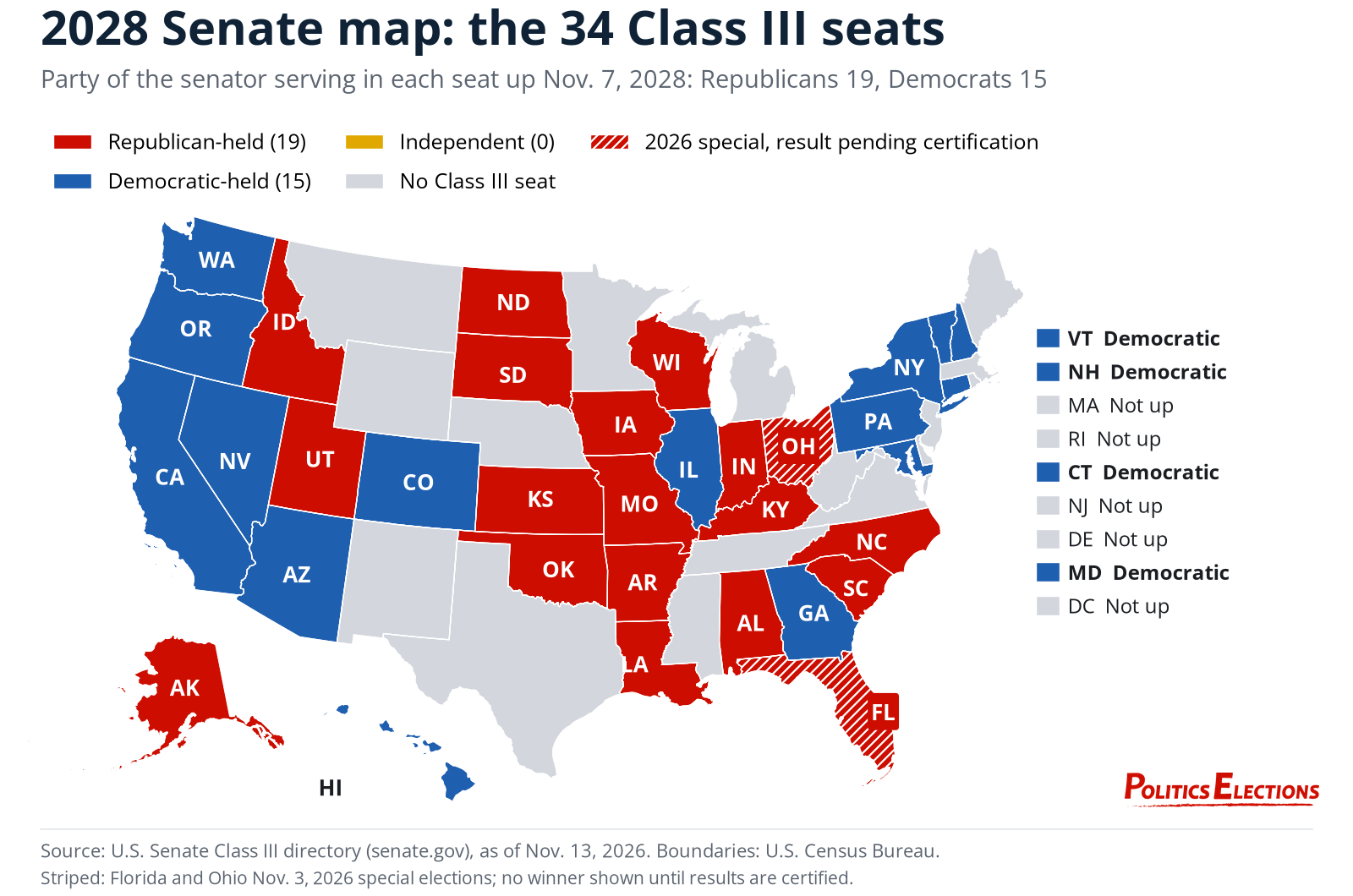
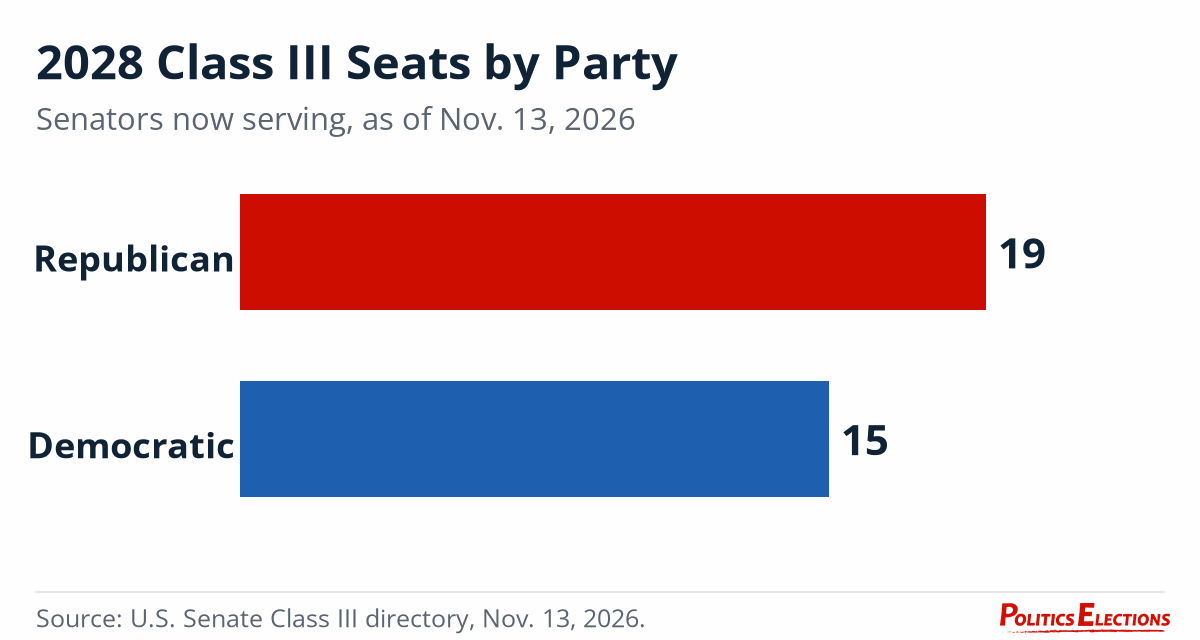
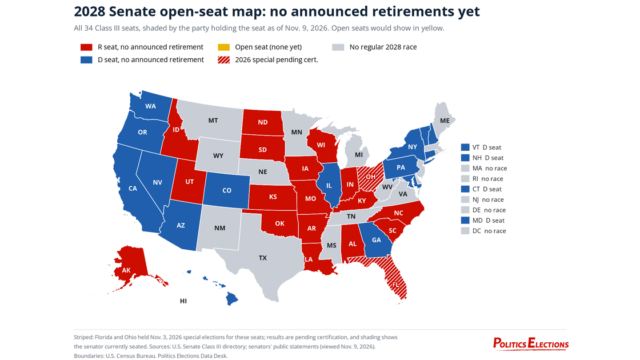
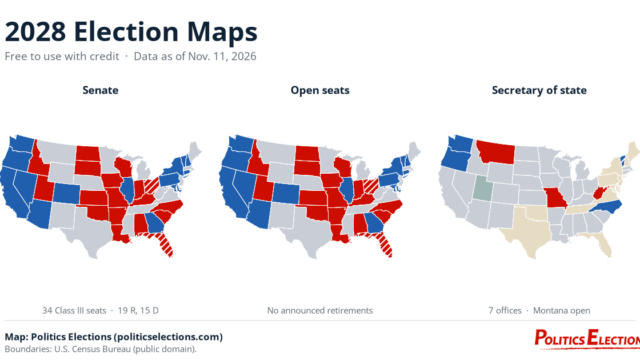
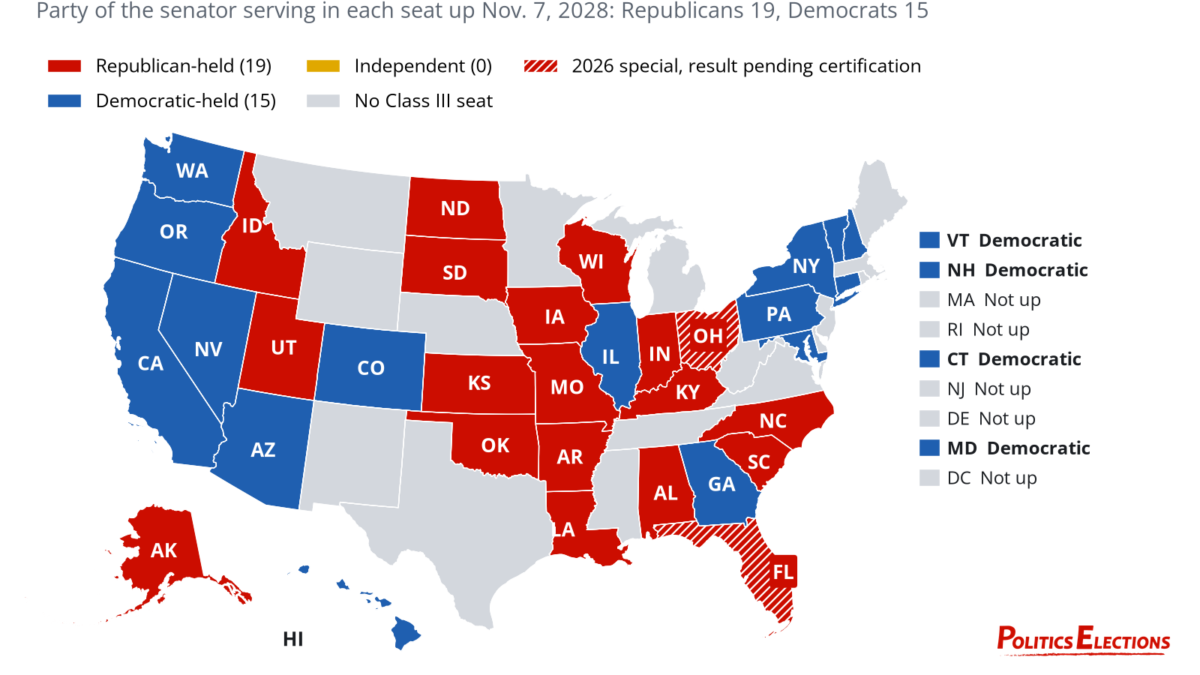
Republicans defend 19 of the 34 seats and Democrats defend 15. That 19-15 split counts current officeholders only. A name on the map is the senator serving now, not a confirmed 2028 candidate.
Two seats carry a procedural note. Florida’s Ashley Moody and Ohio’s Jon Husted were appointed to fill Class III vacancies and were sworn in on Jan. 21, 2025, according to the Congressional Record. Both seats were on the Nov. 3, 2026, ballot in special elections for the rest of the term, according to the Florida Division of Elections and Ohio county candidate lists. Neither result had been certified when this page was updated. Florida’s Elections Canvassing Commission meets on the 14th day after the election, Nov. 17, and Ohio county boards must finish their official canvass by the 21st day, Nov. 24. This page will change a holder only after certification.
All 34 Seats: Senator, 2022 Margin and 2024 Result
The table below lists every 2028 Class III seat with the senator now serving, the year that senator was first sworn in to the Senate, the margin in the seat’s last regular election (2022) and the state’s 2024 presidential margin. Margins are computed from official vote totals published by the Federal Election Commission (2022, 2024) and shown as the winner’s lead in percentage points.
| St. | Senator | Yr. | 2022 Sen. | 2024 Pres. | Lean |
|---|---|---|---|---|---|
| AL | Katie Britt (R) | 2023 | R+35.7 | R+30.5 | Solid R |
| AK | Lisa Murkowski (R) | 2003 | R+7.4 (R vs. R) | R+13.1 | Likely R |
| AZ | Mark Kelly (D) | 2020 | D+4.9 | R+5.5 | BG |
| AR | John Boozman (R) | 2011 | R+34.6 | R+30.6 | Solid R |
| CA | Alex Padilla (D) | 2021 | D+22.1 | D+20.1 | Solid D |
| CO | Michael Bennet (D) | 2009 | D+14.6 | D+11.0 | Likely D |
| CT | Richard Blumenthal (D) | 2011 | D+14.9 | D+14.5 | Likely D |
| FL | Ashley Moody (R, appointed) | 2025 | R+16.4 | R+13.1 | Likely R |
| GA | Raphael Warnock (D) | 2021 | D+2.8 | R+2.2 | BG |
| HI | Brian Schatz (D) | 2012 | D+45.2 | D+23.1 | Solid D |
| ID | Mike Crapo (R) | 1999 | R+31.9 | R+36.5 | Solid R |
| IL | Tammy Duckworth (D) | 2017 | D+15.3 | D+10.9 | Likely D |
| IN | Todd Young (R) | 2017 | R+20.7 | R+19.0 | Solid R |
| IA | Chuck Grassley (R) | 1981 | R+12.2 | R+13.2 | Likely R |
| KS | Jerry Moran (R) | 2011 | R+23.0 | R+16.1 | Solid R |
| KY | Rand Paul (R) | 2011 | R+23.6 | R+30.5 | Solid R |
| LA | John Kennedy (R) | 2017 | R+43.7 | R+22.0 | Solid R |
| MD | Chris Van Hollen (D) | 2017 | D+31.7 | D+28.5 | Solid D |
| MO | Eric Schmitt (R) | 2023 | R+13.3 | R+18.4 | Likely R |
| NV | Catherine Cortez Masto (D) | 2017 | D+0.8 | R+3.1 | BG |
| NH | Maggie Hassan (D) | 2017 | D+9.2 | D+2.8 | BG |
| NY | Chuck Schumer (D) | 1999 | D+14.0 | D+12.6 | Likely D |
| NC | Ted Budd (R) | 2023 | R+3.2 | R+3.2 | BG |
| ND | John Hoeven (R) | 2011 | R+31.4 | R+36.4 | Solid R |
| OH | Jon Husted (R, appointed) | 2025 | R+6.1 | R+11.2 | Lean R |
| OK | James Lankford (R) | 2015 | R+32.2 | R+34.3 | Solid R |
| OR | Ron Wyden (D) | 1996 | D+14.9 | D+14.3 | Likely D |
| PA | John Fetterman (D) | 2023 | D+4.9 | R+1.7 | BG |
| SC | Tim Scott (R) | 2013 | R+25.9 | R+17.9 | Solid R |
| SD | John Thune (R) | 2005 | R+43.5 | R+29.2 | Solid R |
| UT | Mike Lee (R) | 2011 | R+10.4 (vs. ind.) | R+21.6 | Likely R |
| VT | Peter Welch (D) | 2023 | D+40.4 | D+31.5 | Solid D |
| WA | Patty Murray (D) | 1993 | D+14.5 | D+18.2 | Likely D |
| WI | Ron Johnson (R) | 2011 | R+1.0 | R+0.9 | BG |
St.: state postal code. Yr.: year first sworn in. 2022 Sen.: 2022 Senate margin. 2024 Pres.: 2024 presidential margin (R = Trump, D = Harris). Lean: PE lean; BG = Battleground.
Notes: Alaska’s 2022 margin is the final ranked-choice round, in which both finalists were Republicans. Georgia’s is the Dec. 6, 2022, runoff. Utah’s runner-up, Evan McMullin, ran as an independent. Connecticut and New York totals combine each candidate’s fusion-party lines. In Florida and Ohio, the 2022 winners later left the Senate, and the current senators were appointed. Data: download the full 34-seat table as CSV.
2024 Presidential Margin by State
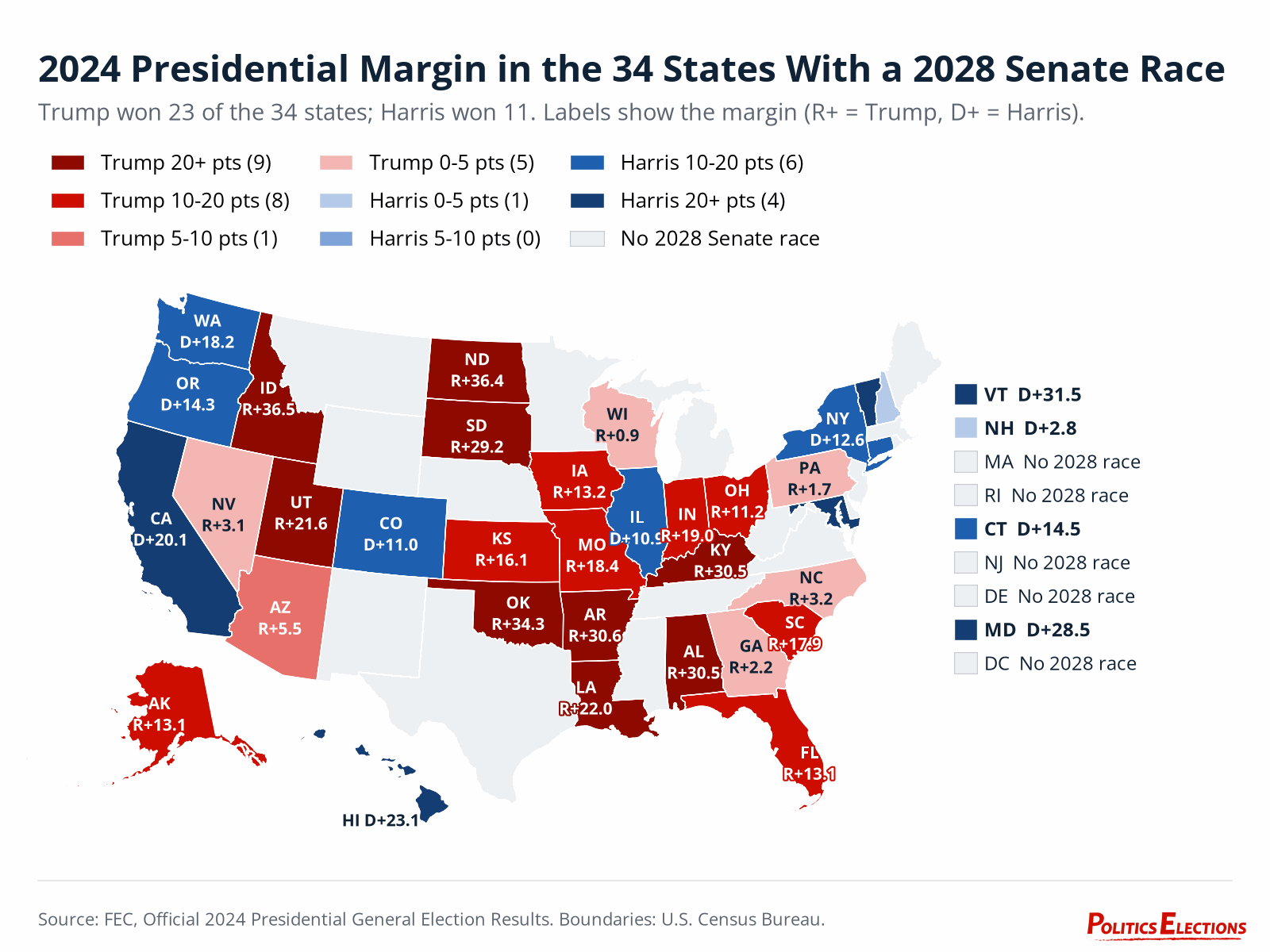
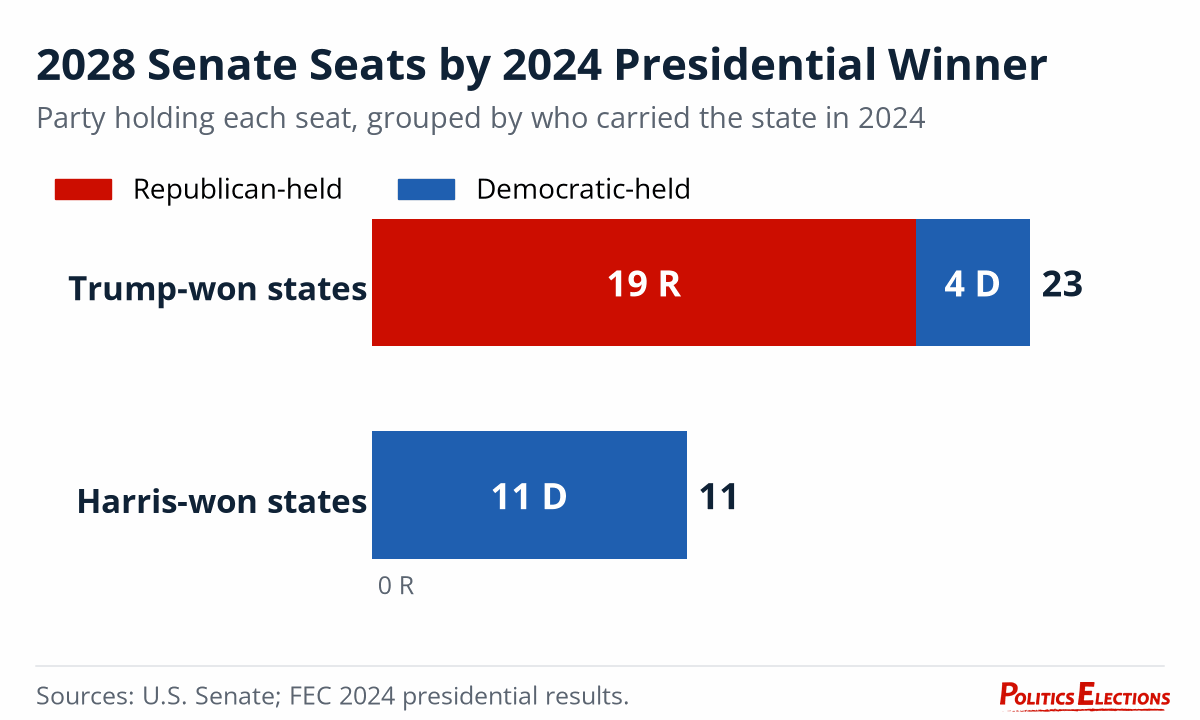
Trump carried 23 of the 34 states with a 2028 Senate race; Harris carried 11. All 19 Republican-held seats are in states Trump won. Four Democratic-held seats are, too: Arizona, Georgia, Nevada and Pennsylvania. No Republican holds a 2028 seat in a state Harris won. That is the clearest structural fact on this map, and it makes those four states natural Republican targets.
| State | Held by | Trump | Harris | Margin |
|---|---|---|---|---|
| Idaho | R | 66.9% | 30.4% | Trump +36.5 |
| North Dakota | R | 67.0% | 30.5% | Trump +36.4 |
| Oklahoma | R | 66.2% | 31.9% | Trump +34.3 |
| Arkansas | R | 64.2% | 33.6% | Trump +30.6 |
| Kentucky | R | 64.5% | 33.9% | Trump +30.5 |
| Alabama | R | 64.6% | 34.1% | Trump +30.5 |
| South Dakota | R | 63.4% | 34.2% | Trump +29.2 |
| Louisiana | R | 60.2% | 38.2% | Trump +22.0 |
| Utah | R | 59.4% | 37.8% | Trump +21.6 |
| Indiana | R | 58.6% | 39.6% | Trump +19.0 |
| Missouri | R | 58.5% | 40.1% | Trump +18.4 |
| South Carolina | R | 58.2% | 40.4% | Trump +17.9 |
| Kansas | R | 57.2% | 41.0% | Trump +16.1 |
| Iowa | R | 55.7% | 42.5% | Trump +13.2 |
| Alaska | R | 54.5% | 41.4% | Trump +13.1 |
| Florida | R | 56.1% | 43.0% | Trump +13.1 |
| Ohio | R | 55.1% | 43.9% | Trump +11.2 |
| Arizona | D | 52.2% | 46.7% | Trump +5.5 |
| North Carolina | R | 50.9% | 47.6% | Trump +3.2 |
| Nevada | D | 50.6% | 47.5% | Trump +3.1 |
| Georgia | D | 50.7% | 48.5% | Trump +2.2 |
| Pennsylvania | D | 50.2% | 48.5% | Trump +1.7 |
| Wisconsin | R | 49.6% | 48.7% | Trump +0.9 |
| New Hampshire | D | 47.9% | 50.7% | Harris +2.8 |
| Illinois | D | 43.5% | 54.4% | Harris +10.9 |
| Colorado | D | 43.1% | 54.1% | Harris +11.0 |
| New York | D | 43.3% | 55.9% | Harris +12.6 |
| Oregon | D | 41.0% | 55.3% | Harris +14.3 |
| Connecticut | D | 41.9% | 56.4% | Harris +14.5 |
| Washington | D | 39.0% | 57.2% | Harris +18.2 |
| California | D | 38.3% | 58.5% | Harris +20.1 |
| Hawaii | D | 37.5% | 60.6% | Harris +23.1 |
| Maryland | D | 34.1% | 62.6% | Harris +28.5 |
| Vermont | D | 32.3% | 63.8% | Harris +31.5 |
Vote shares and margins come from the FEC’s official 2024 presidential general election results. Margin = Trump share minus Harris share of all votes cast for president.
2022 Senate Margins, Closest to Widest

Six 2022 races were decided by less than 5 points: Nevada (0.8), Wisconsin (1.0), Georgia (2.8, runoff), North Carolina (3.2), Arizona (4.9) and Pennsylvania (4.9). Republicans won two of those six, Wisconsin and North Carolina, and Democrats won four. At the other end, 15 seats were decided by 20 points or more.
The 2022 margin is a starting point, not a forecast. It reflects the 2022 candidates and a midterm electorate. A presidential-year turnout in 2028 can shift the picture, which is why this page pairs each 2022 result with the 2024 presidential result.
Seat-by-Seat PE Lean
Neither the Cook Political Report nor Sabato’s Crystal Ball had published 2028 Senate ratings when Politics Elections checked on Nov. 13, 2026. Cook’s Senate ratings page and the Crystal Ball’s Senate page both cover the 2026 cycle. Until they publish, this page uses a PE lean: a simple, transparent formula from Politics Elections, not an outside rating.
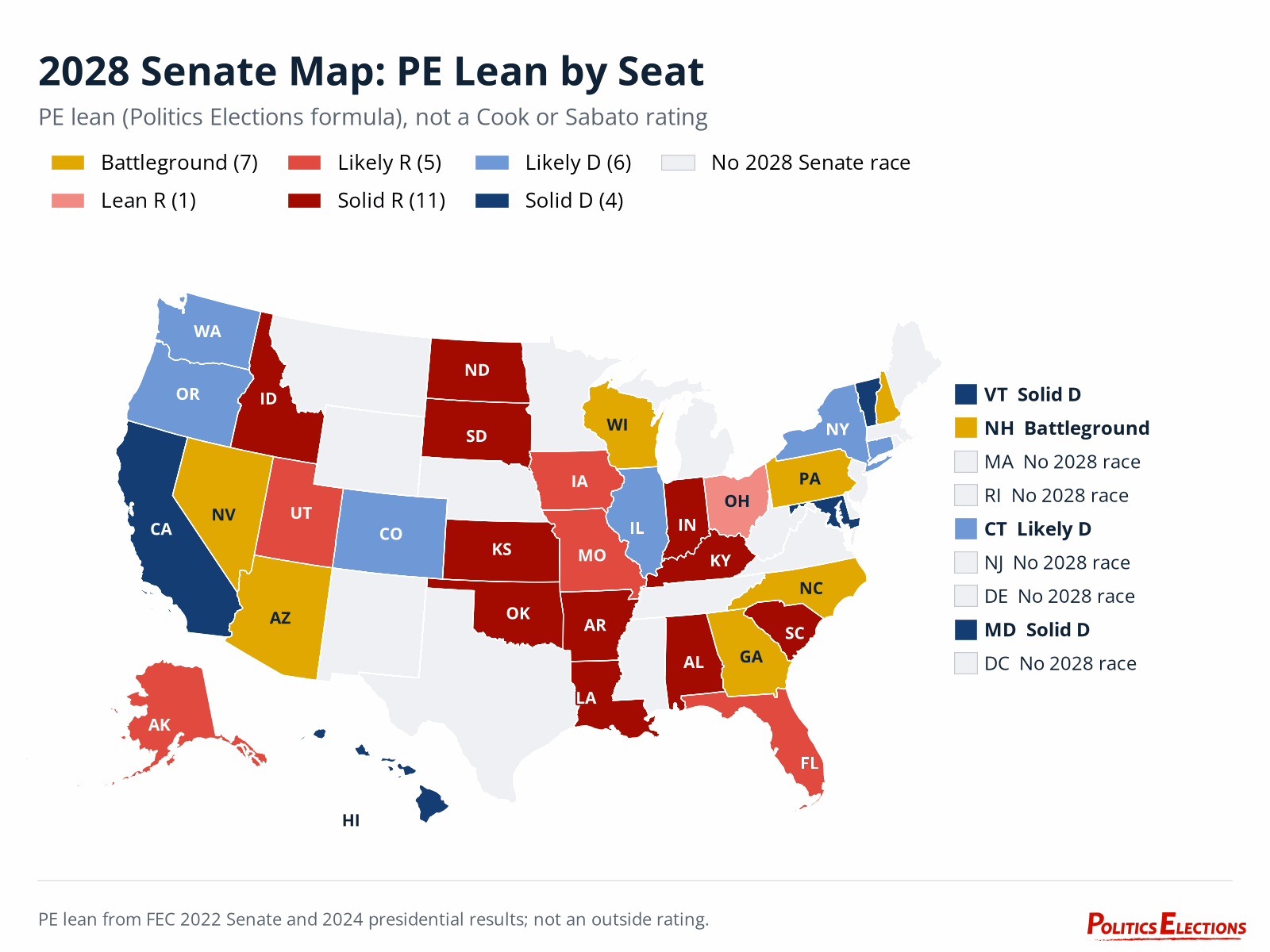
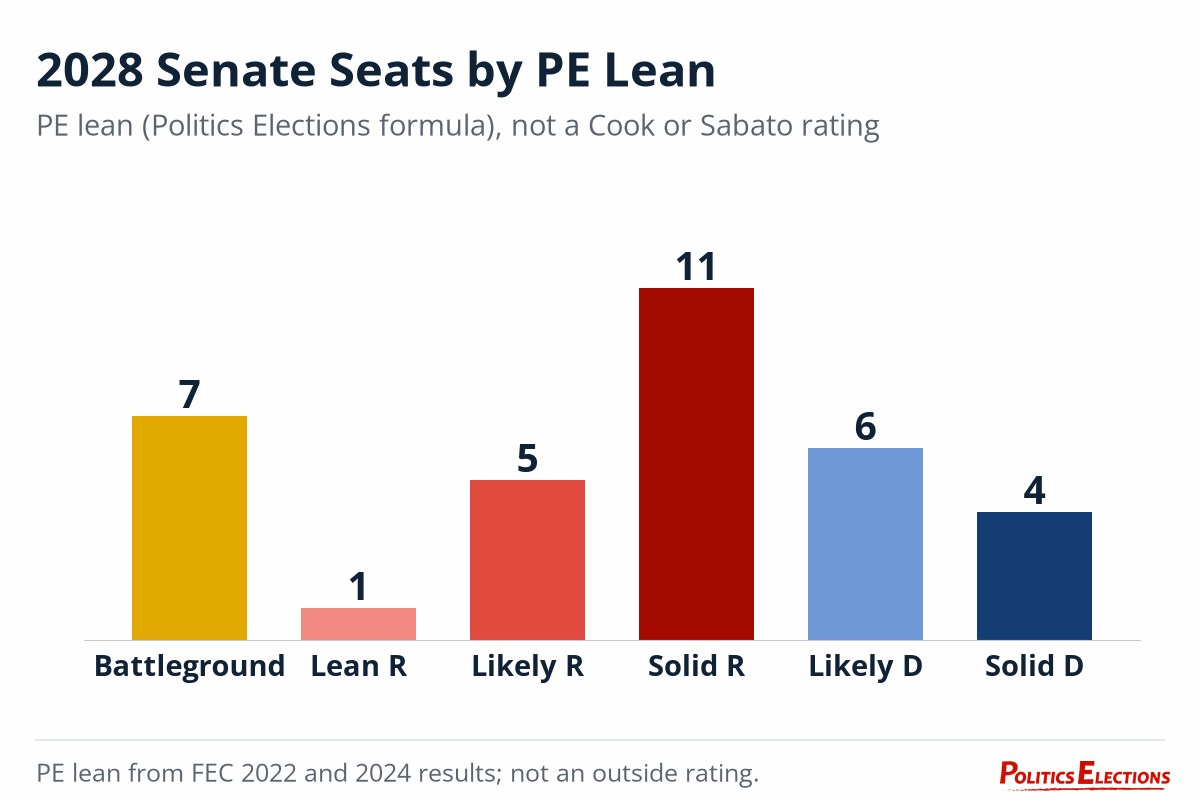
How the PE lean works: It uses two official numbers for each seat, the 2022 Senate margin and the 2024 presidential margin. A seat is a Battleground if the senator’s party lost the state in 2024, or if either margin is under 5 points. Otherwise the closer of the two margins sets the label: Lean (5 to 10 points), Likely (10 to 15) or Solid (15 or more), for the party holding the seat. Alaska uses only its 2024 margin because its 2022 final round matched two Republicans. The PE lean ignores candidates, money and the national environment, and it does not apply any 2026 results.
See the formula for every seat
| State | Held by | Lean | Why |
|---|---|---|---|
| Arizona | D | Battleground | Democratic senator in a state Trump won by 5.5 points in 2024; 2022 Senate margin D+4.9. |
| Georgia | D | Battleground | Democratic senator in a state Trump won by 2.2 points in 2024; 2022 Senate margin D+2.8. |
| Nevada | D | Battleground | Democratic senator in a state Trump won by 3.1 points in 2024; 2022 Senate margin D+0.8. |
| New Hampshire | D | Battleground | Closer of the two margins is under 5 points (2024 presidential D+2.8; 2022 Senate D+9.2). |
| North Carolina | R | Battleground | Closer of the two margins is under 5 points (2024 presidential R+3.2; 2022 Senate R+3.2). |
| Pennsylvania | D | Battleground | Democratic senator in a state Trump won by 1.7 points in 2024; 2022 Senate margin D+4.9. |
| Wisconsin | R | Battleground | Closer of the two margins is under 5 points (2024 presidential R+0.9; 2022 Senate R+1.0). |
| Ohio | R | Lean R | Both margins favor the seat-holder’s party; the closer one is 5-10 points (2024 presidential R+11.2; 2022 Senate R+6.1). |
| Alaska | R | Likely R | Trump won Alaska by 13.1 points in 2024; the 2022 race was a Republican-vs-Republican ranked-choice final, so only the 2024 margin is used. |
| Florida | R | Likely R | Both margins favor the seat-holder’s party; the closer one is 10-15 points (2024 presidential R+13.1; 2022 Senate R+16.4). |
| Iowa | R | Likely R | Both margins favor the seat-holder’s party; the closer one is 10-15 points (2024 presidential R+13.2; 2022 Senate R+12.2). |
| Missouri | R | Likely R | Both margins favor the seat-holder’s party; the closer one is 10-15 points (2024 presidential R+18.4; 2022 Senate R+13.3). |
| Utah | R | Likely R | Trump R+21.6; Lee won by 10.4 points over an independent in 2022. Closer measure is 10-15 points. |
| Alabama | R | Solid R | Both margins favor the seat-holder’s party; the closer one is 15 or more points (2024 presidential R+30.5; 2022 Senate R+35.7). |
| Arkansas | R | Solid R | Both margins favor the seat-holder’s party; the closer one is 15 or more points (2024 presidential R+30.6; 2022 Senate R+34.6). |
| Idaho | R | Solid R | Both margins favor the seat-holder’s party; the closer one is 15 or more points (2024 presidential R+36.5; 2022 Senate R+31.9). |
| Indiana | R | Solid R | Both margins favor the seat-holder’s party; the closer one is 15 or more points (2024 presidential R+19.0; 2022 Senate R+20.7). |
| Kansas | R | Solid R | Both margins favor the seat-holder’s party; the closer one is 15 or more points (2024 presidential R+16.1; 2022 Senate R+23.0). |
| Kentucky | R | Solid R | Both margins favor the seat-holder’s party; the closer one is 15 or more points (2024 presidential R+30.5; 2022 Senate R+23.6). |
| Louisiana | R | Solid R | Both margins favor the seat-holder’s party; the closer one is 15 or more points (2024 presidential R+22.0; 2022 Senate R+43.7). |
| North Dakota | R | Solid R | Both margins favor the seat-holder’s party; the closer one is 15 or more points (2024 presidential R+36.4; 2022 Senate R+31.4). |
| Oklahoma | R | Solid R | Both margins favor the seat-holder’s party; the closer one is 15 or more points (2024 presidential R+34.3; 2022 Senate R+32.2). |
| South Carolina | R | Solid R | Both margins favor the seat-holder’s party; the closer one is 15 or more points (2024 presidential R+17.9; 2022 Senate R+25.9). |
| South Dakota | R | Solid R | Both margins favor the seat-holder’s party; the closer one is 15 or more points (2024 presidential R+29.2; 2022 Senate R+43.5). |
| Colorado | D | Likely D | Both margins favor the seat-holder’s party; the closer one is 10-15 points (2024 presidential D+11.0; 2022 Senate D+14.6). |
| Connecticut | D | Likely D | Both margins favor the seat-holder’s party; the closer one is 10-15 points (2024 presidential D+14.5; 2022 Senate D+14.9). |
| Illinois | D | Likely D | Both margins favor the seat-holder’s party; the closer one is 10-15 points (2024 presidential D+10.9; 2022 Senate D+15.3). |
| New York | D | Likely D | Both margins favor the seat-holder’s party; the closer one is 10-15 points (2024 presidential D+12.6; 2022 Senate D+14.0). |
| Oregon | D | Likely D | Both margins favor the seat-holder’s party; the closer one is 10-15 points (2024 presidential D+14.3; 2022 Senate D+14.9). |
| Washington | D | Likely D | Both margins favor the seat-holder’s party; the closer one is 10-15 points (2024 presidential D+18.2; 2022 Senate D+14.5). |
| California | D | Solid D | Both margins favor the seat-holder’s party; the closer one is 15 or more points (2024 presidential D+20.1; 2022 Senate D+22.1). |
| Hawaii | D | Solid D | Both margins favor the seat-holder’s party; the closer one is 15 or more points (2024 presidential D+23.1; 2022 Senate D+45.2). |
| Maryland | D | Solid D | Both margins favor the seat-holder’s party; the closer one is 15 or more points (2024 presidential D+28.5; 2022 Senate D+31.7). |
| Vermont | D | Solid D | Both margins favor the seat-holder’s party; the closer one is 15 or more points (2024 presidential D+31.5; 2022 Senate D+40.4). |
By this formula, seven seats are Battlegrounds: five held by Democrats (Arizona, Georgia, Nevada, New Hampshire and Pennsylvania) and two held by Republicans (North Carolina and Wisconsin). One more Republican seat, Ohio, is Lean R. Of the remaining 26, 16 are Solid or Likely Republican and 10 are Solid or Likely Democratic.
Races to Watch in 2028
Cutoff used here: a seat makes the list if its 2022 Senate margin or the state’s 2024 presidential margin was under 5 points, or if the senator’s party lost the state in the 2024 presidential race. Seven seats qualify.
| State | Senator | 2022 Sen. | 2024 Pres. | Why listed |
|---|---|---|---|---|
| NV | Catherine Cortez Masto (D) | D+0.8 | Trump +3.1 | Democratic-held seat in a Trump-won state |
| WI | Ron Johnson (R) | R+1.0 | Trump +0.9 | Margin under 5 points |
| PA | John Fetterman (D) | D+4.9 | Trump +1.7 | Democratic-held seat in a Trump-won state |
| GA | Raphael Warnock (D) | D+2.8 | Trump +2.2 | Democratic-held seat in a Trump-won state |
| NH | Maggie Hassan (D) | D+9.2 | Harris +2.8 | Margin under 5 points |
| NC | Ted Budd (R) | R+3.2 | Trump +3.2 | Margin under 5 points |
| AZ | Mark Kelly (D) | D+4.9 | Trump +5.5 | Democratic-held seat in a Trump-won state |
States use postal codes. 2022 Sen.: 2022 Senate margin. 2024 Pres.: 2024 presidential margin.
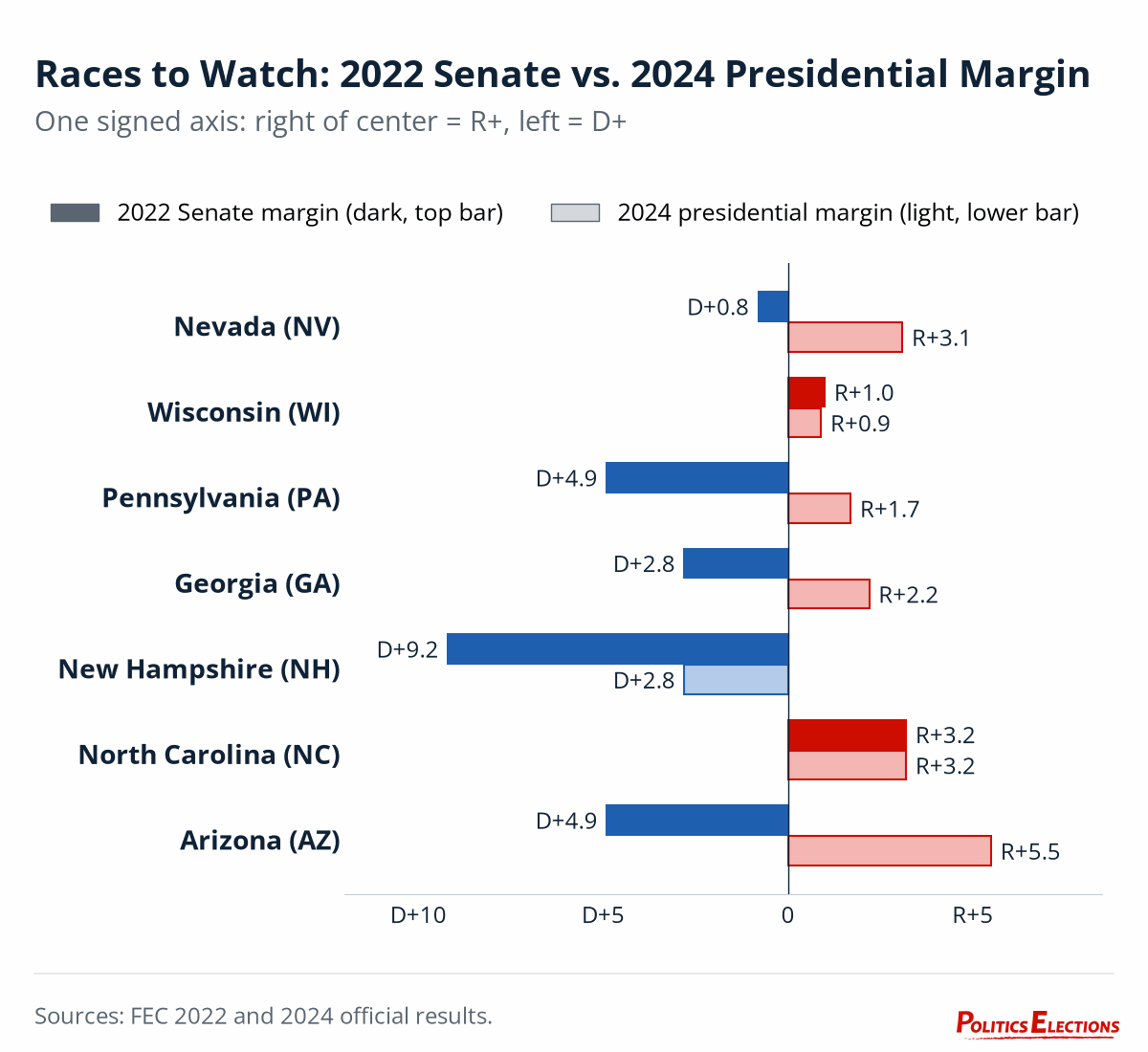
Five of the seven are Democratic seats, and four of those five are in states Trump carried. For Republicans, the math starts with Arizona, Georgia, Nevada and Pennsylvania. For Democrats, the targets are Wisconsin and North Carolina, the two Republican seats where both margins were under 4 points. New Hampshire is the only seat on the list in a state Harris won.
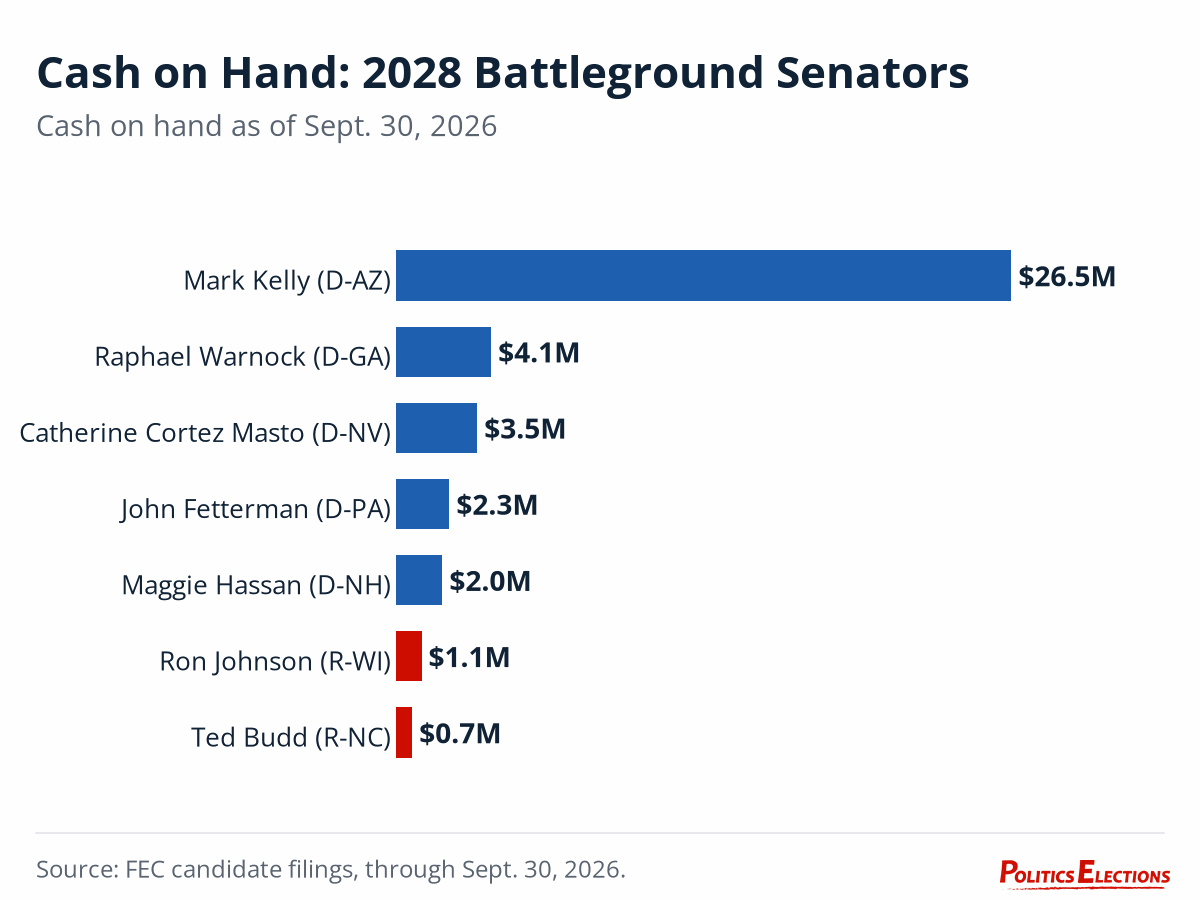
Money is one early signal. Through Sept. 30, 2026, the seven incumbents reported these cash-on-hand totals for 2028 to the FEC:
| State | Inc. | Party | Raised | Cash |
|---|---|---|---|---|
| Arizona | Mark Kelly | D | $58.4M | $26.5M |
| Georgia | Raphael Warnock | D | $8.4M | $4.1M |
| Nevada | Catherine Cortez Masto | D | $5.9M | $3.5M |
| Pennsylvania | John Fetterman | D | $10.4M | $2.3M |
| New Hampshire | Maggie Hassan | D | $6.1M | $2.0M |
| Wisconsin | Ron Johnson | R | $6.6M | $1.1M |
| North Carolina | Ted Budd | R | $3.9M | $0.7M |
Inc.: incumbent. Raised: total raised toward 2028 since Jan. 2023. Cash: cash on hand as of Sept. 30, 2026.
Figures come from each senator’s FEC filings for the 2028 election period. Cash on hand measures resources, not votes. Fundraising is likewise an indicator of resources, and challengers’ totals will change once fields form.
Open Seats and Retirements
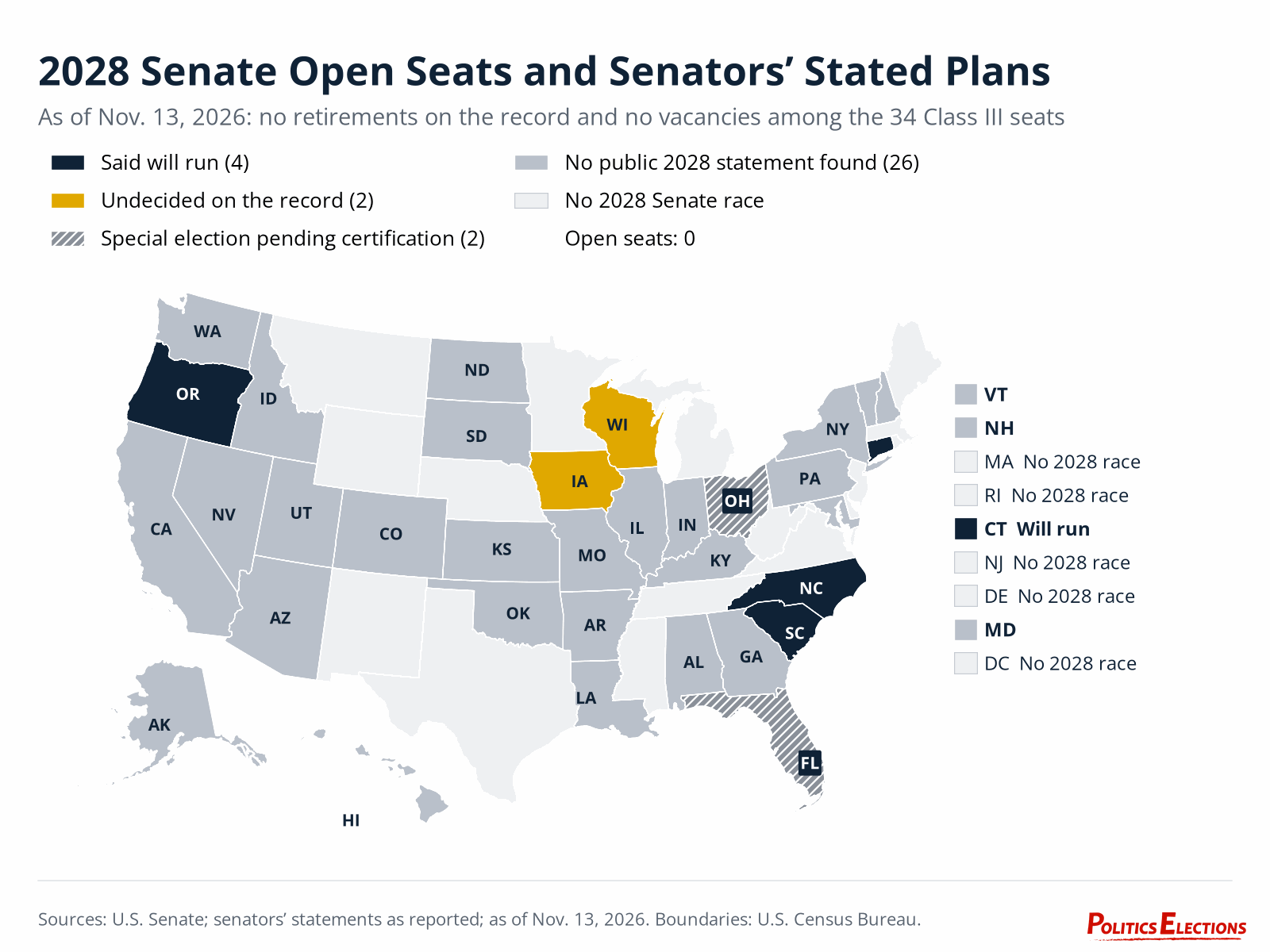
As of Nov. 13, 2026, no Class III senator has announced a retirement on the record and no Class III seat is vacant. Politics Elections’ 2028 Senate open-seat map tracks that count and dates each change.
A few senators have spoken on the record about 2028:
- Said they will run: South Carolina’s Tim Scott said he will seek re-election (Post and Courier, March 18, 2026). North Carolina’s Ted Budd told the Washington Examiner, “That’s the plan. Absolutely, I’m in” (Nov. 10, 2026). Oregon’s Ron Wyden said he fully intends to run (OPB, April 29, 2025). Connecticut’s Richard Blumenthal said he looks forward to being on the 2028 ballot but had no formal announcement (WBUR/Connecticut Mirror, Nov. 5, 2026).
- Undecided on the record: Iowa’s Chuck Grassley said he would not decide until next year (Iowa’s News Now, Oct. 13, 2026). Wisconsin’s Ron Johnson said in May 2025 that he does not want to run again but would not rule it out (WSAW, May 29, 2025).
- No public 2028 statement found in Politics Elections’ Nov. 13 review: the other 26 senators, including Moody and Husted, whose specials are pending certification.
An undecided senator is not an open seat. A seat counts as open on this page only after an on-the-record retirement or a vacancy.
Path to 51
A Senate majority is 51 of 100 seats. At 50-50, the vice president, as president of the Senate, casts the tie-breaking vote, so 50 seats plus the vice presidency also controls the chamber. The vice president in 2029 will be decided by the 2028 presidential election.
The 2029 Senate will combine three blocks of seats:
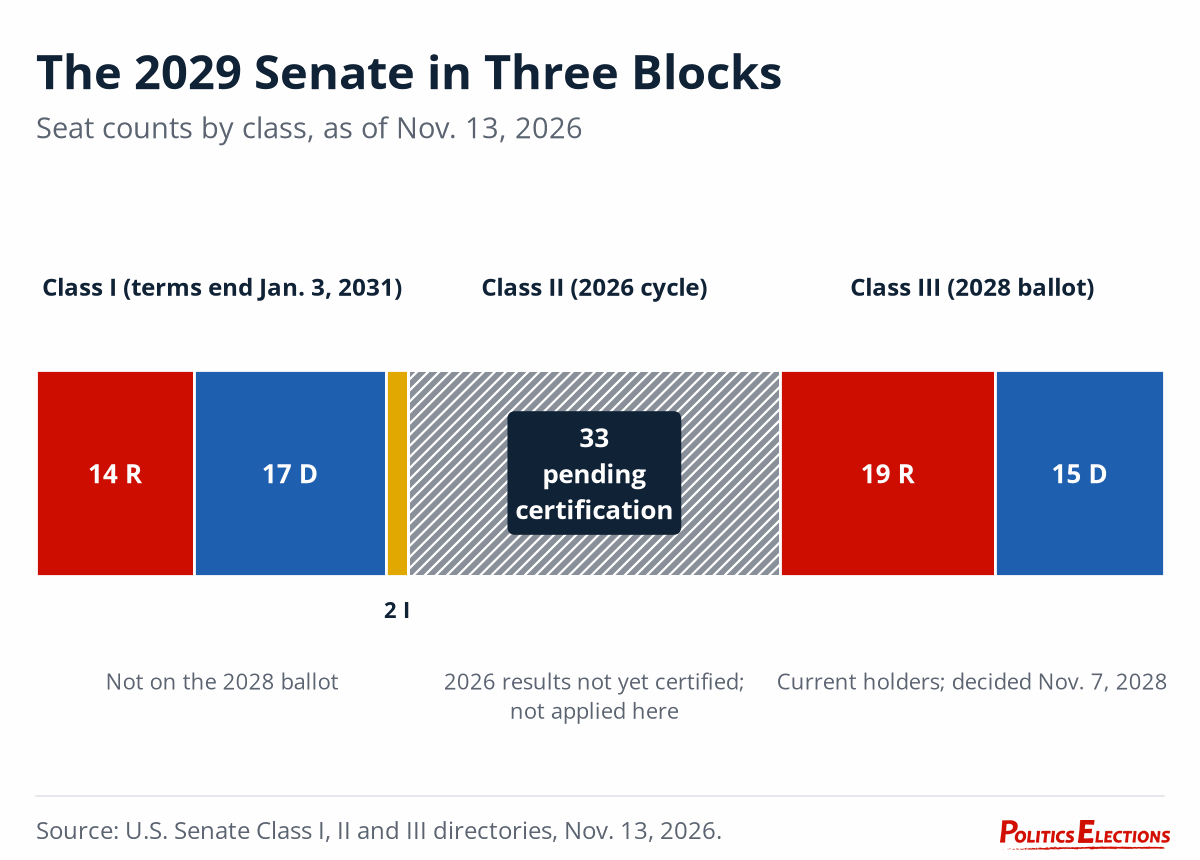
| Block | Seats | Status |
|---|---|---|
| Class I (terms end Jan. 3, 2031) | 33: 14 Republicans, 17 Democrats, 2 independents | Not on the 2028 ballot |
| Class II (2026 cycle) | 33 | 2026 results not yet certified; not applied here |
| Class III (2028 ballot) | 34: 19 Republicans, 15 Democrats now | Decided Nov. 7, 2028 |
Seat counts come from the Senate’s Class I, Class II and Class III directories, viewed Nov. 13, 2026.
Republicans hold 14 Class I seats that are not up until 2030. To reach 51 in January 2029, they need 37 of the 67 seats in Classes II and III combined, or 36 with a Republican vice president. Put another way: Class III seats Republicans need = 37 minus the Class II seats they hold after 2026 certification (36 minus that number with a Republican vice president).
Politics Elections will apply the certified 2026 Class II results, and the Florida and Ohio specials, once states certify them. Each state certifies on its own schedule; see the state certification deadlines. The filibuster’s 60-vote threshold is a separate question from the 51-seat majority.
State-by-State Analysis
Each entry gives the senator, the 2022 Senate margin, the 2024 presidential margin and the PE lean. All figures are from the FEC sources above. Battlegrounds come first, then the rest of the map by PE lean.
Battlegrounds
Nevada (Catherine Cortez Masto, D). The closest 2022 Senate race on this map: Cortez Masto beat Adam Laxalt by 0.8 points, 48.8% to 48.0%. Trump carried Nevada by 3.1 points in 2024, 50.6% to 47.5%. PE lean: Battleground. No public 2028 statement from Cortez Masto was found.
Wisconsin (Ron Johnson, R). Johnson won a third term by 1.0 point over Mandela Barnes, and Trump carried the state by 0.9 points. Both margins are the narrowest of any Republican-held seat. Johnson said in May 2025 that he does not want to run again but has not ruled it out, and Republican businessman Eric Hovde told WisPolitics he would consider a run if Johnson does not. PE lean: Battleground.
Georgia (Raphael Warnock, D). Warnock won the Dec. 6, 2022, runoff by 2.8 points over Herschel Walker after a first round in which no one cleared 50%. Trump carried Georgia by 2.2 points in 2024. A Democratic seat in a Trump-won state; PE lean: Battleground.
North Carolina (Ted Budd, R). Budd won his open-seat race by 3.2 points over Cheri Beasley, and Trump carried the state by the same 3.2-point margin. Budd announced on Nov. 10, 2026, that he will seek a second term, which keeps the seat from opening. PE lean: Battleground.
Pennsylvania (John Fetterman, D). Fetterman won the 2022 open seat by 4.9 points over Mehmet Oz. Trump carried Pennsylvania by 1.7 points in 2024. Fetterman has not announced 2028 plans, and writer Ahmed Moor announced a Democratic primary challenge on Nov. 9, 2026. PE lean: Battleground.
New Hampshire (Maggie Hassan, D). Hassan won by 9.2 points in 2022, but Harris carried the state by only 2.8 points, 50.7% to 47.9%. It is the one Battleground in a Harris-won state. PE lean: Battleground.
Arizona (Mark Kelly, D). Kelly won by 4.9 points over Blake Masters in 2022, while Trump carried Arizona by 5.5 points in 2024. Kelly reported $26.5 million in cash on hand through Sept. 30, 2026, the most of any 2028 battleground incumbent. A Democratic seat in a Trump-won state; PE lean: Battleground.
Lean and Likely Republican
Ohio (Jon Husted, R, appointed). The seat’s last regular race, in 2022, went Republican by 6.1 points, and Trump carried Ohio by 11.2 points in 2024. The Nov. 3, 2026, special election for this seat is pending certification. PE lean: Lean R.
Iowa (Chuck Grassley, R). Grassley won by 12.2 points in 2022, and Trump carried Iowa by 13.2. Grassley, in the Senate since 1981, says he will decide on 2028 next year. PE lean: Likely R.
Utah (Mike Lee, R). Lee beat independent Evan McMullin by 10.4 points in 2022, with no Democrat on the ballot. Trump carried Utah by 21.6. PE lean: Likely R.
Alaska (Lisa Murkowski, R). Murkowski won the final ranked-choice round over fellow Republican Kelly Tshibaka, 53.7% to 46.3%. Trump carried Alaska by 13.1 points. PE lean: Likely R, based on the 2024 margin only.
Florida (Ashley Moody, R, appointed). The 2022 regular race went Republican by 16.4 points, and Trump carried Florida by 13.1 in 2024. The Nov. 3, 2026, special is pending certification, with the state canvassing commission set to meet Nov. 17. PE lean: Likely R.
Missouri (Eric Schmitt, R). Schmitt won his first term by 13.3 points; Trump carried Missouri by 18.4. PE lean: Likely R.
Solid Republican
Alabama (Katie Britt). 2022: R+35.7. 2024: Trump +30.5. Arkansas (John Boozman). 2022: R+34.6. 2024: Trump +30.6. Idaho (Mike Crapo). 2022: R+31.9. 2024: Trump +36.5. Indiana (Todd Young). 2022: R+20.7. 2024: Trump +19.0. Kansas (Jerry Moran). 2022: R+23.0. 2024: Trump +16.1. Kentucky (Rand Paul). 2022: R+23.6. 2024: Trump +30.5. Louisiana (John Kennedy). Won outright in the November 2022 all-candidate election by 43.7 points over the top Democrat. 2024: Trump +22.0. North Dakota (John Hoeven). 2022: R+31.4. 2024: Trump +36.4. Oklahoma (James Lankford). 2022: R+32.2. 2024: Trump +34.3. South Carolina (Tim Scott). 2022: R+25.9. 2024: Trump +17.9. Scott has said he will seek re-election. South Dakota (John Thune). 2022: R+43.5. 2024: Trump +29.2.
Likely and Solid Democratic
Colorado (Michael Bennet). 2022: D+14.6. 2024: Harris +11.0. Likely D. Illinois (Tammy Duckworth). 2022: D+15.3. 2024: Harris +10.9. Likely D. New York (Chuck Schumer). 2022: D+14.0. 2024: Harris +12.6. Likely D. Oregon (Ron Wyden). 2022: D+14.9. 2024: Harris +14.3. Likely D; Wyden says he intends to run. Connecticut (Richard Blumenthal). 2022: D+14.9. 2024: Harris +14.5. Likely D. Washington (Patty Murray). 2022: D+14.5. 2024: Harris +18.2. Likely D. California (Alex Padilla). 2022: D+22.1. 2024: Harris +20.1. Solid D. Hawaii (Brian Schatz). 2022: D+45.2. 2024: Harris +23.1. Solid D. Maryland (Chris Van Hollen). 2022: D+31.7. 2024: Harris +28.5. Solid D. Vermont (Peter Welch). 2022: D+40.4. 2024: Harris +31.5. Solid D.
For how these seats line up with the presidential map, see the 2028 swing state map and the 2028 Electoral College map.
Candidates and Filings to Watch
This list includes only candidates who filed a statement of candidacy (FEC Form 2) for a 2028 Senate race and reported raising at least $10,000, candidates who announced on the record, and named people who said on the record they are considering a run. It excludes rumored names.
| State | Name | Party | Type | Status |
|---|---|---|---|---|
| PA | Ahmed Moor | D | Challenger (Democratic primary) | Announced a bid for the Democratic nomination Nov. 9, 2026; FEC Form 2 dated Nov. 9, 2026 |
| WI | Katrina Deville | D | Challenger | FEC Form 2 dated Aug. 13, 2026; $38,632 raised through Sept. 30, 2026 |
| NY | Heidi Cochran | D | Challenger (Democratic primary) | FEC Form 2 first filed May 16, 2026; $12,356 raised through Sept. 30, 2026 |
| WI | Eric Hovde | R | Possible (on record) | Told WisPolitics he would consider a run if Johnson does not seek another term (published Nov. 10, 2026); no 2028 FEC filing found |
FEC records list a 2028 Senate registration for 32 of the 34 sitting Class III senators; the exceptions are the two appointees, Florida’s Moody and Ohio’s Husted. A registration does not by itself mean a senator has announced a run. Full filings: FEC 2028 Senate candidate list.
2028 Senate Map Questions
How many Senate seats are up in 2028?
Thirty-four regular Class III seats. Special elections could add others if vacancies occur.
Which Senate seats are up in 2028?
The Class III seats in Alabama, Alaska, Arizona, Arkansas, California, Colorado, Connecticut, Florida, Georgia, Hawaii, Idaho, Illinois, Indiana, Iowa, Kansas, Kentucky, Louisiana, Maryland, Missouri, Nevada, New Hampshire, New York, North Carolina, North Dakota, Ohio, Oklahoma, Oregon, Pennsylvania, South Carolina, South Dakota, Utah, Vermont, Washington and Wisconsin.
What states have Senate elections in 2028?
The same 34 states. Each has one seat on the regular ballot. A second race in the same state would happen only through a special election.
What is Senate Class III?
One of three groups the Constitution uses to stagger Senate terms. Class III’s current terms end Jan. 3, 2029, so those seats are on the 2028 ballot.
Which senators are up for election in 2028?
The 34 senators in the table above, from Katie Britt of Alabama to Ron Johnson of Wisconsin. Being on the list means a senator holds the seat now, not that they are running.
When is the 2028 Senate election?
Tuesday, Nov. 7, 2028, the same day as the presidential election.
When do winners take office?
At noon on Jan. 3, 2029, under the 20th Amendment.
How many Republican and Democratic seats are up in 2028?
Republicans hold 19 and Democrats hold 15, as of Nov. 13, 2026, per the Senate’s Class III directory. The Florida and Ohio specials were pending certification on that date.
How many 2028 Senate seats are in states Trump won?
Twenty-three of 34. Republicans hold 19 of them and Democrats hold four: Arizona, Georgia, Nevada and Pennsylvania.
Are there 2028 Senate ratings yet?
Not from Cook or Sabato’s Crystal Ball as of Nov. 13, 2026. This page uses a labeled PE lean based on 2022 and 2024 results until they publish.
Related Politics Elections Maps
- 2028 Senate open-seat map
- 2028 election maps data pack
- 2028 Electoral College map
- 2028 swing state map
- 2028 governor map
- 2028 House map
- 2028 presidential primary calendar