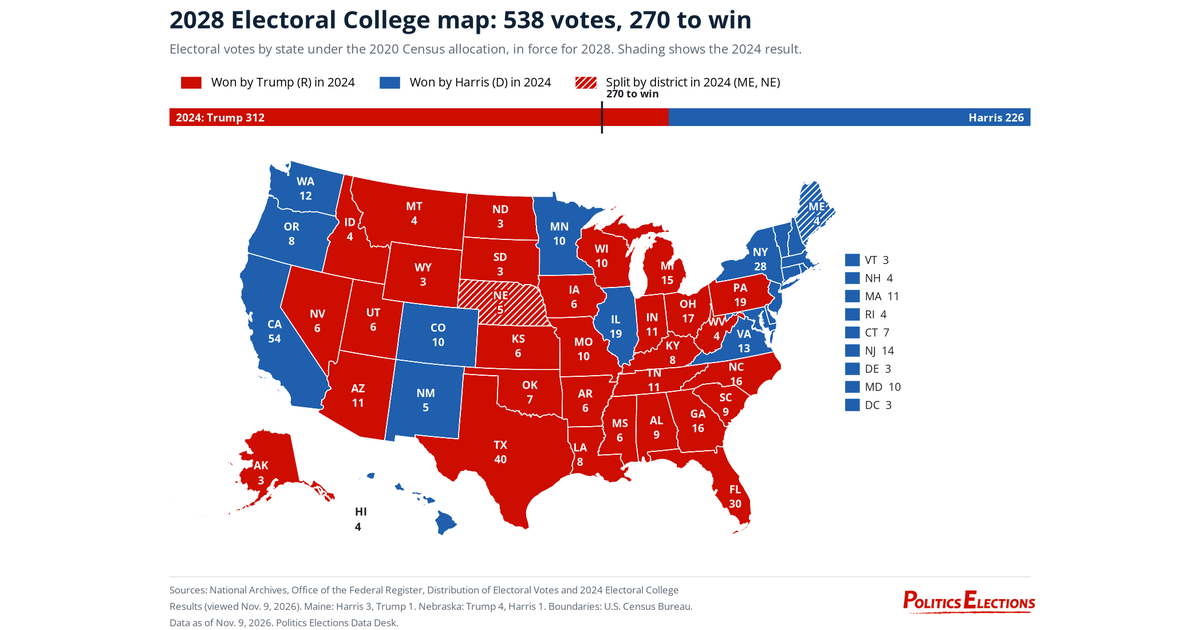
The numbers: The 2028 electoral college map covers 538 electors, and a candidate needs 270 to win the presidency. The allocation comes from the 2020 Census and applies to both the 2024 and 2028 elections, according to the National Archives. In the 2024 baseline, Donald Trump won 312 electoral votes and Kamala Harris won 226.
Data as of November 9, 2026; 2024 results are the official Electoral College count. Sources listed below.
How Many Electoral Votes Does Each State Have in 2028?
Each state receives one electoral vote for each of its two U.S. senators and one for each of its U.S. House seats. Under the 23rd Amendment, the District of Columbia receives three. The National Archives’ distribution of electoral votes states that the current allocation is based on the 2020 Census and is effective for the 2024 and 2028 presidential elections. The 2028 general election is scheduled for November 7, 2028.
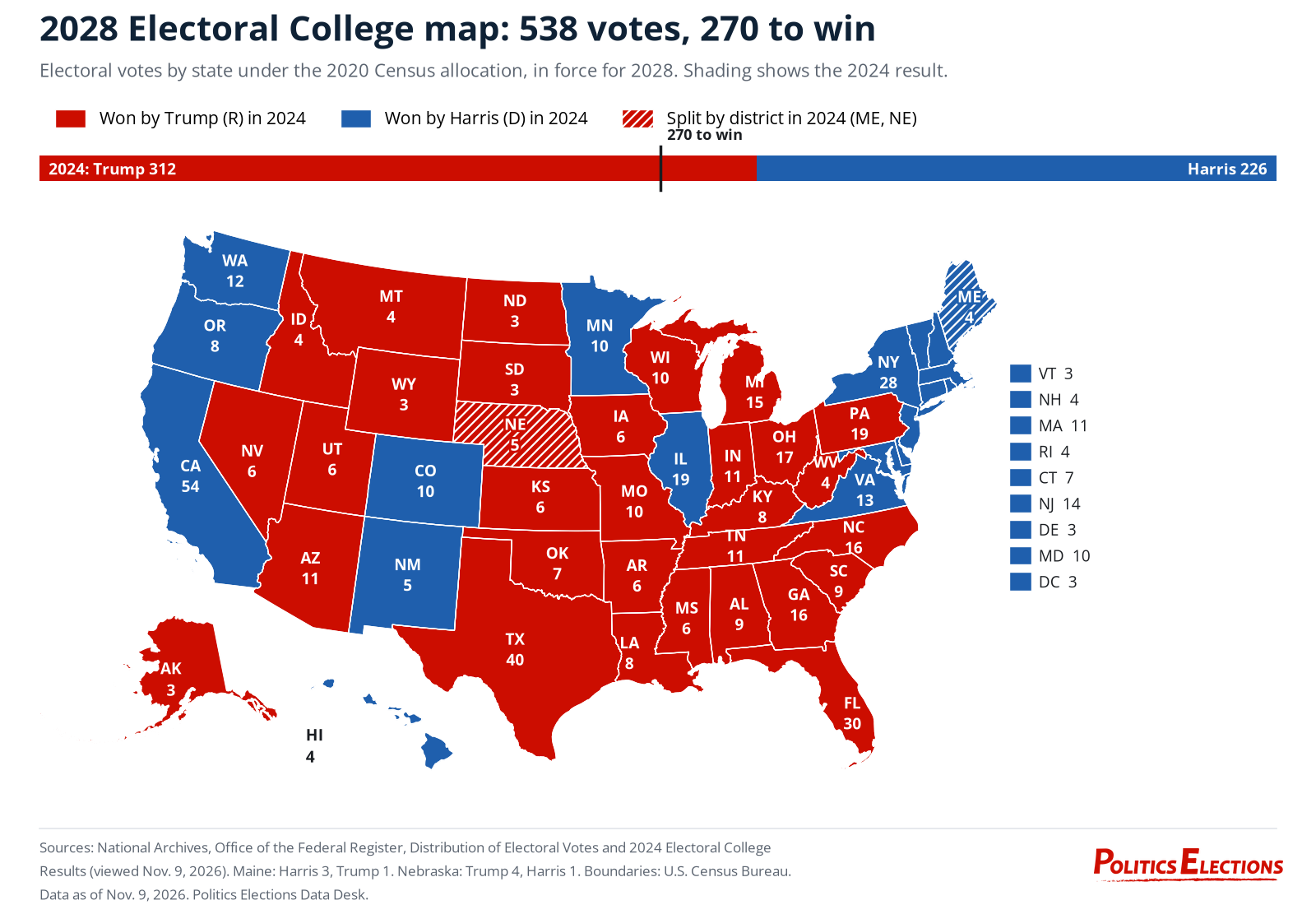
The map uses the 2024 result as a dated baseline, not a forecast. Shading shows how each state voted in the most recent presidential election under the same allocation that will be used in 2028.
Electoral Votes by State: Full Table
| State | 2028 electoral votes | 2024 winner | Official source |
|---|---|---|---|
| Alabama | 9 | Trump (R) | National Archives |
| Alaska | 3 | Trump (R) | National Archives |
| Arizona | 11 | Trump (R) | National Archives |
| Arkansas | 6 | Trump (R) | National Archives |
| California | 54 | Harris (D) | National Archives |
| Colorado | 10 | Harris (D) | National Archives |
| Connecticut | 7 | Harris (D) | National Archives |
| Delaware | 3 | Harris (D) | National Archives |
| District of Columbia | 3 | Harris (D) | National Archives |
| Florida | 30 | Trump (R) | National Archives |
| Georgia | 16 | Trump (R) | National Archives |
| Hawaii | 4 | Harris (D) | National Archives |
| Idaho | 4 | Trump (R) | National Archives |
| Illinois | 19 | Harris (D) | National Archives |
| Indiana | 11 | Trump (R) | National Archives |
| Iowa | 6 | Trump (R) | National Archives |
| Kansas | 6 | Trump (R) | National Archives |
| Kentucky | 8 | Trump (R) | National Archives |
| Louisiana | 8 | Trump (R) | National Archives |
| Maine | 4 | Split: Harris 3, Trump 1 | National Archives |
| Maryland | 10 | Harris (D) | National Archives |
| Massachusetts | 11 | Harris (D) | National Archives |
| Michigan | 15 | Trump (R) | National Archives |
| Minnesota | 10 | Harris (D) | National Archives |
| Mississippi | 6 | Trump (R) | National Archives |
| Missouri | 10 | Trump (R) | National Archives |
| Montana | 4 | Trump (R) | National Archives |
| Nebraska | 5 | Split: Trump 4, Harris 1 | National Archives |
| Nevada | 6 | Trump (R) | National Archives |
| New Hampshire | 4 | Harris (D) | National Archives |
| New Jersey | 14 | Harris (D) | National Archives |
| New Mexico | 5 | Harris (D) | National Archives |
| New York | 28 | Harris (D) | National Archives |
| North Carolina | 16 | Trump (R) | National Archives |
| North Dakota | 3 | Trump (R) | National Archives |
| Ohio | 17 | Trump (R) | National Archives |
| Oklahoma | 7 | Trump (R) | National Archives |
| Oregon | 8 | Harris (D) | National Archives |
| Pennsylvania | 19 | Trump (R) | National Archives |
| Rhode Island | 4 | Harris (D) | National Archives |
| South Carolina | 9 | Trump (R) | National Archives |
| South Dakota | 3 | Trump (R) | National Archives |
| Tennessee | 11 | Trump (R) | National Archives |
| Texas | 40 | Trump (R) | National Archives |
| Utah | 6 | Trump (R) | National Archives |
| Vermont | 3 | Harris (D) | National Archives |
| Virginia | 13 | Harris (D) | National Archives |
| Washington | 12 | Harris (D) | National Archives |
| West Virginia | 4 | Trump (R) | National Archives |
| Wisconsin | 10 | Trump (R) | National Archives |
| Wyoming | 3 | Trump (R) | National Archives |
Swipe to see more →
The table totals 538. The National Archives’ 2024 results page lists 312 electoral votes for Trump and 226 for Harris, with no change to the state allocations between 2024 and 2028.
Where the 2024 Electoral Votes Landed
Trump carried 31 states, including Nebraska’s statewide vote, plus Maine’s 2nd Congressional District. Those states are Alabama, Alaska, Arizona, Arkansas, Florida, Georgia, Idaho, Indiana, Iowa, Kansas, Kentucky, Louisiana, Michigan, Mississippi, Missouri, Montana, Nebraska, Nevada, North Carolina, North Dakota, Ohio, Oklahoma, Pennsylvania, South Carolina, South Dakota, Tennessee, Texas, Utah, West Virginia, Wisconsin and Wyoming.
Harris carried 19 states and the District of Columbia, plus Nebraska’s 2nd Congressional District: California, Colorado, Connecticut, Delaware, Hawaii, Illinois, Maine, Maryland, Massachusetts, Minnesota, New Hampshire, New Jersey, New Mexico, New York, Oregon, Rhode Island, Vermont, Virginia and Washington.
Arizona, Georgia, Michigan, Nevada, North Carolina, Pennsylvania and Wisconsin, all carried by Trump in 2024, together hold 93 electoral votes. That inventory describes the last result; it is not a ranking of 2028 competitiveness.
What Changed After the 2020 Census
The 2020 reapportionment moved seven House seats, and the electoral votes moved with them. According to the Census Bureau’s 2020 apportionment data, Texas gained two seats, while Colorado, Florida, Montana, North Carolina and Oregon each gained one. California, Illinois, Michigan, New York, Ohio, Pennsylvania and West Virginia each lost one.
Mid-decade redistricting does not change these totals. A state that redraws its congressional districts keeps the same number of House seats, so its electoral vote count stays the same until the next reapportionment after the 2030 Census. For the maps in use for the House, see our guide to states with new House maps.
Maine and Nebraska Split by District
Every state except Maine and Nebraska awards all of its electors to the statewide winner, according to the National Archives. Maine and Nebraska award two electors to the statewide winner and one to the winner of each congressional district. In 2024, Maine gave Harris 3 votes and Trump 1, and Nebraska gave Trump 4 votes and Harris 1.
Both states considered switching to winner-take-all during their 2025-2026 sessions. Nebraska’s LB3 was indefinitely postponed on April 17, 2026, and Maine’s LD 1356, which would have taken effect only if Nebraska switched first, died on adjournment on April 29, 2026. As of this article’s date, both states’ district systems remain in place for 2028. A state can still change its method by law before Election Day.
For how the 270 threshold works, what happens if no candidate reaches it and the status of the National Popular Vote Compact, see our explainer on how the Electoral College works.
How to Track the Map Through 2028
The allocation is fixed for 2028, so the numbers on this map will not change. What will change is the list of candidates, set by state ballot-access rules and party nominations. The presidential nominating calendar is in our 2028 presidential primary calendar.
After the November 7, 2028 vote, federal law sets the next steps. Electors meet on the first Tuesday after the second Wednesday in December under 3 U.S.C. 7, which falls on December 19, 2028. Congress counts the electoral votes on January 6 unless it sets another date by law, under 3 U.S.C. 15. The new presidential term begins at noon on January 20, 2029, under the 20th Amendment.
The same ballot will carry other federal and state races. See the 2028 Senate map of all 34 Class III seats and the 2028 governor map.
What the Map Does and Doesn’t Tell You
The map shows how many votes each state controls and how each state voted last time. It does not show who the 2028 nominees will be, how close any state will be or which states campaigns will target. Those depend on candidates, turnout and the political environment in 2028.
The 2024 baseline does show the scale of the last result: Trump’s 312 electoral votes were 42 more than the 270 needed to win.
Electoral College Map Questions
How many electoral votes are needed to win in 2028? 270 of 538.
Do electoral votes change between 2024 and 2028? No. The National Archives says the 2020 Census allocation is effective for both elections.
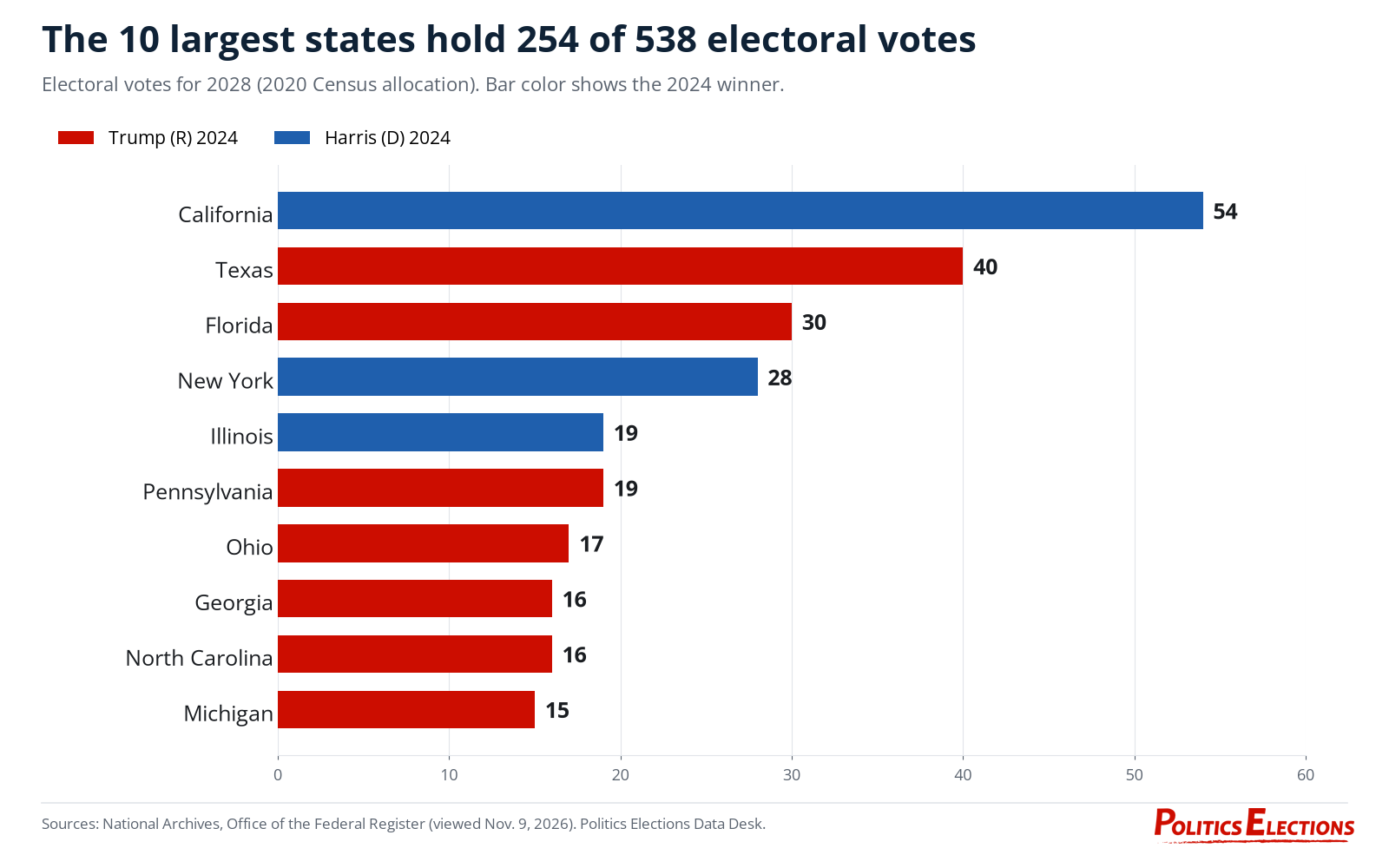
Which state has the most electoral votes? California, with 54, followed by Texas with 40 and Florida with 30.
Which states can split their electoral votes? Maine and Nebraska, which award one elector per congressional district.
When will electoral votes change next? After the 2030 Census reapportionment, starting with the 2032 presidential election.
Sources
- National Archives: Distribution of Electoral Votes
- National Archives: 2024 Electoral College Results
- U.S. Census Bureau: 2020 Census Apportionment Results
- National Archives: Constitution, Amendments 11-27 (23rd and 20th Amendments)
- 3 U.S.C. 7: Meeting and vote of electors
- 3 U.S.C. 15: Counting electoral votes in Congress
- Nebraska Legislature: LB3 (109th Legislature) status
- Maine Legislature: LD 1356 (132nd Legislature) status