Federal law guarantees a provisional ballot to voters whose eligibility is questioned at the polls. About three in four were counted in 2024, and every state that offers one must let voters check the result.
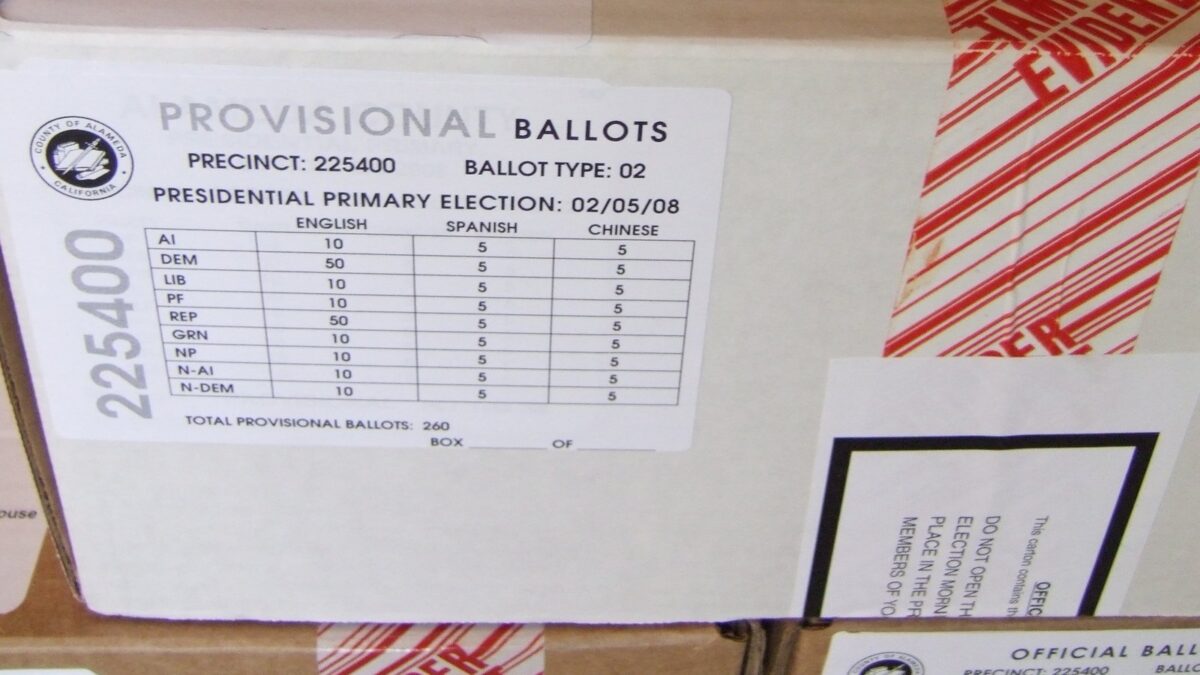
What is a provisional ballot? It is a ballot cast by a voter whose eligibility cannot be confirmed at the polling place. It is set aside instead of going straight into the count, and election officials decide afterward whether the voter was eligible. If so, the ballot is counted.
The right to one comes from the Help America Vote Act of 2002, known as HAVA. Section 302, codified at 52 U.S.C. 21082, has required it in federal elections since Jan. 1, 2004. With Election Day on Tuesday, Nov. 3, here is when a voter gets a provisional ballot, how to find out whether it counted, and how long some states give voters to fix a problem.
What is a provisional ballot, and when do you get one?
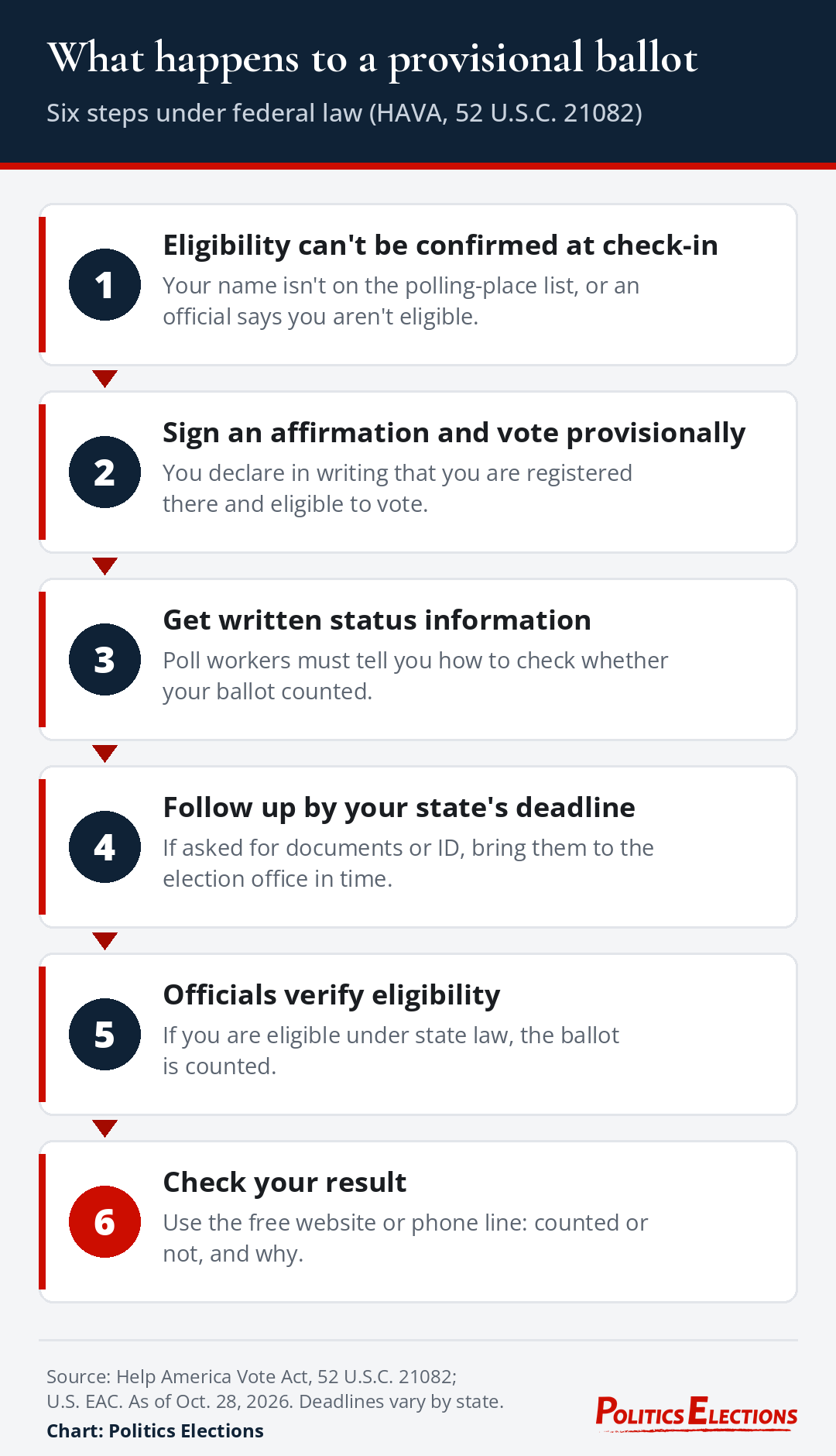
Under HAVA, a voter who says they are registered in the jurisdiction and eligible to vote in a federal election must be allowed to cast a provisional ballot if their name is not on the official list for that polling place, or if an election official asserts that they are not eligible. The voter signs a written affirmation, and the ballot goes to election officials for verification.
The law also covers late voting. If a court order keeps polls open past their normal closing time, every ballot cast during the extra time must be provisional and kept separate from other provisional ballots.
The U.S. Election Assistance Commission boils the law down to three requirements:
“HAVA includes 3 main requirements for provisional voting: Voters must be offered a provisional ballot; Election officials must count eligible provisional ballots; and Election officials must provide a free access system with information on whether a provisional ballot is counted.”
U.S. Election Assistance Commission, Overview of Federal Election Laws
Some states are exempt. HAVA’s provisional ballot rule does not apply to states that offered Election Day registration at the polls when the law passed, which the EAC lists as Idaho, Minnesota, New Hampshire, Wisconsin and Wyoming. North Dakota, which has no voter registration, is also exempt. Voters in the five same-day states can register at the polls on Election Day instead. In practice, the EAC’s 2024 survey found that only Idaho, Minnesota, New Hampshire and North Dakota did not offer provisional ballots. For the current list of states with that option, see the Politics Elections guide to same-day voter registration by state.
How many provisional ballots count
States reported 1,736,209 provisional ballots cast in the 2024 general election, according to the EAC’s 2024 Election Administration and Voting Survey report. The EAC found that 0.9% of voters whose ballots counted had voted provisionally. Of those provisional ballots, 73.8% were counted in full or in part, and 25.1% were rejected.
The most common reason a voter cast a provisional ballot was that their name was not on the voter list, at 40.2%. Slightly more than one-quarter were cast by voters using same-day registration. Ten states told the EAC they routinely use provisional ballots for same-day registrants: Alaska, Arkansas, Kansas, Montana, Nevada, New Mexico, New York, Utah, Virginia and West Virginia. Two other reasons, a name or address that had not been updated and a mail ballot the voter did not surrender at the polls, each accounted for slightly under 15%.
In states with voter ID requirements, a voter who cannot show an accepted ID at the polls is generally offered a provisional ballot and a short window to return with one, a topic covered in the Politics Elections look at voter ID ballot measures in six states.
How to check whether your provisional ballot counted
HAVA requires every state and local office that issues provisional ballots to run a free status system, and poll workers must give each provisional voter written information about it. The statute spells out what the system must do:
“The appropriate State or local election official shall establish a free access system (such as a toll-free telephone number or an Internet website) that any individual who casts a provisional ballot may access to discover whether the vote of that individual was counted, and, if the vote was not counted, the reason that the vote was not counted.”
Help America Vote Act, 52 U.S.C. 21082(a)(5)(B)
Access is limited to the voter who cast the ballot. In practice, the receipt or notice a voter gets at the polls explains how to look up the result, and results are not available right away. Examples from official state pages:
- North Carolina: Provisional voters receive a Provisional Identification Number and can check status online with that number and their date of birth, or by calling the State Board of Elections at (866) 522-4723. Status “will not be available earlier than 10 days after the date of the election,” according to the State Board of Elections.
- Pennsylvania: County boards decide within seven days after the election. Status is available beginning seven days after the election through the state’s provisional ballot search or 1-877-VOTESPA, using the identification number on the voter’s receipt, according to the Pennsylvania Department of State.
- Florida: The Notice of Rights given to provisional voters explains how to find out whether the ballot counted, and the information should be available “no later than 30 days following the election,” according to the Florida Division of Elections.
Provisional ballot deadlines: examples from six states
When election officials need more from a voter before a provisional ballot can count, state law sets a short deadline to supply it. Missing the deadline can keep the ballot from being counted. The table below lists examples taken from official state pages and statutes. It is not a complete list, and rules differ by the reason the ballot was provisional.
| State | Deadline | Where to go | Official source |
|---|---|---|---|
| Florida | 5 p.m. local time on the second day after the election | County supervisor of elections | Florida Division of Elections |
| Georgia | Within three days after Election Day | County registrar’s office | Georgia.gov |
| Michigan | 6 days | City or township clerk | Michigan Department of State |
| North Carolina | Noon on the fifth business day after Election Day | County board of elections office | N.C. State Board of Elections |
| Ohio | Within four days after the election | County board of elections office | Ohio Rev. Code 3505.181 |
| Texas | Within six calendar days of the election | County voter registrar’s office | VoteTexas.gov |
Provisional ballots and certification
Provisional ballots are reviewed during the canvass, the official tally that follows Election Day. HAVA says an eligible voter’s provisional ballot “shall be counted as a vote in that election in accordance with State law,” so the cure windows above have to close before counties can finish their counts. The state-by-state timeline that follows is laid out in the Politics Elections guide to election results certification deadlines.
What voters can do
- Check registration before Election Day. A name missing from the voter list was the top reason for provisional ballots in 2024. State and county election websites offer a registration lookup.
- Bring a mail ballot if one was requested. Voters who requested a mail ballot but vote in person may be asked to surrender it, and the EAC found that not surrendering a mail ballot accounted for slightly under 15% of 2024 provisional ballots.
- Keep the receipt. It has the information needed to check the result.
- Meet the state deadline. If told to bring documents to the election office, do it within the state’s window.
About this explainer
Federal requirements are from the text of 52 U.S.C. 21082 and the U.S. Election Assistance Commission. National figures are from the EAC’s 2024 Election Administration and Voting Survey. State deadlines and status-check details are quoted or summarized from each state’s official election website or statute, as checked on Oct. 28, 2026. States are included only where an official page states the deadline; others were left out. Rules can change, so voters should confirm with their county election office.